What is a Tax Saving Fund?
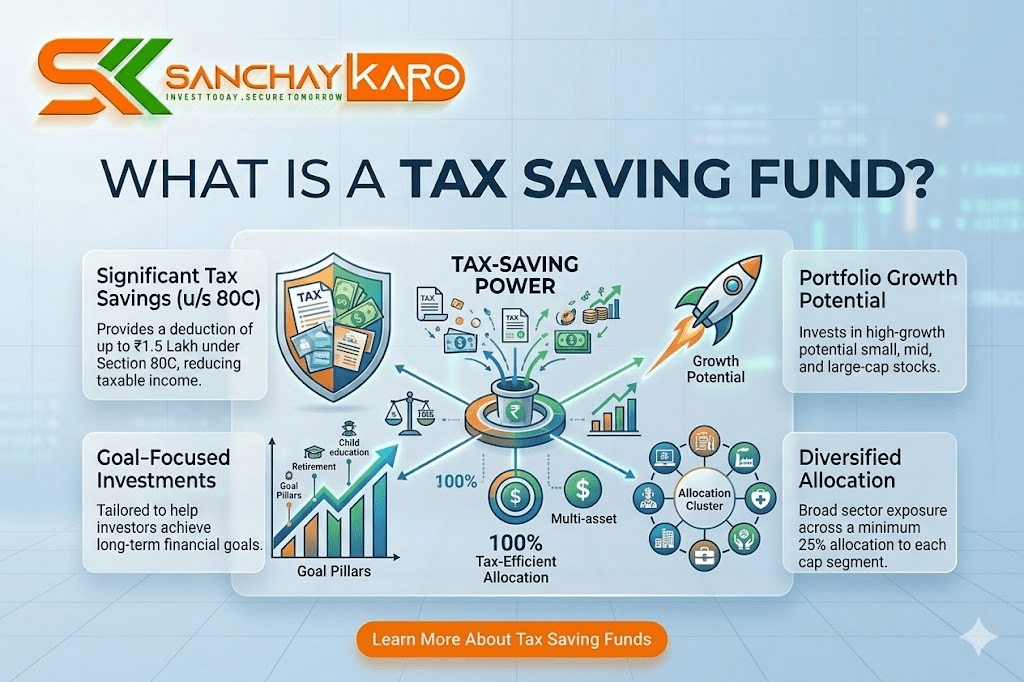
A Tax Saving Fund is another name for an Equity Linked Savings Scheme (ELSS) . It is a type of equity mutual fund that offers dual benefits of tax saving and wealth creation. These funds invest at least 80% of their total assets in equity and equity-related instruments of companies across different market caps and sectors.
When you invest in an ELSS fund, you get two major advantages: first, you can claim tax deduction under Section 80C of the Income Tax Act, and second, your money grows by investing in the stock market, which has historically offered much higher returns than traditional options like FDs or PPF.
Key Highlights:
- Tax Saving Fund is also known as ELSS (Equity Linked Savings Scheme).
- You can claim tax deduction up to ₹1.5 lakh per financial year under Section 80C.
- These funds come with a mandatory lock-in period of 3 years – the shortest among all tax-saving instruments.
- They are equity-oriented, meaning they carry market risk but also offer higher return potential.
As per SEBI rules, an ELSS fund must invest at least 80% of its total assets in equity and equity-related instruments in accordance with the provisions of the Equity Linked Saving Scheme (ELSS), 2005. The remaining (up to 20%) of the fund’s assets may be invested in other instruments such as debt or money market instruments, depending on the fund manager’s strategy.
How Does a Tax Saving Fund Work? (Step-by-Step)
ELSS funds pool money from many investors. A professional fund manager then invests that money across a basket of equity stocks from different sectors and market capitalizations (large cap, mid cap, small cap).
Here is a simple example: Suppose you invest ₹1.5 lakh in an ELSS fund. The fund manager will allocate at least ₹1.2 lakh (80%) to equity stocks of carefully selected companies. The remaining 20% can be in debt, money market instruments, or cash. Your money is now spread across many growing businesses, which gives you diversification and the chance to earn higher returns.
ELSS funds also offer you the flexibility to invest either through a lump sum (one-time investment) or through a Systematic Investment Plan (SIP) . SIP allows you to invest small amounts regularly (like ₹500 or ₹1000 per month). This helps you benefit from rupee cost averaging and brings down the effective cost of investment.
Key Features of Tax Saving Funds (ELSS)
| Feature | What It Means |
|---|---|
| SEBI Mandate of 80% | At least 80% of assets must be in equity and equity-related instruments. |
| Open-ended | After the lock-in period, you can buy or sell units on any business day. |
| Lock-in Period of 3 Years | You cannot withdraw your money before 3 years. This is the shortest lock-in among all Section 80C options. |
| Tax Deduction under Section 80C | Invest up to ₹1.5 lakh per year and reduce your taxable income by the same amount (only under the old tax regime). |
| High Return Potential | Since ELSS funds invest mostly in equities, they offer the potential for inflation-beating returns over the long term. |
| No Maximum Investment Limit | While only ₹1.5 lakh is tax-deductible, you can invest any amount. |
| SIP Option Available | Start with as little as ₹500 per month. |
| Professional Management | Expert fund managers handle all investment decisions. |
Benefits of Investing in Tax Saving Funds
Here are the main benefits of adding an ELSS fund to your mutual fund portfolio:
| Benefit | Why It Matters |
|---|---|
| Tax Savings | You can claim tax deduction of up to ₹1.5 lakh under Section 80C. For someone in the 30% tax bracket, this can save up to ₹46,800 in taxes every year. |
| Shortest Lock-in Period | ELSS funds have a lock-in period of just 3 years. Compare this with PPF (15 years), tax-saving FDs (5 years), or NSC (5 years). ELSS offers the shortest lock-in among all tax-saving options. |
| Higher Return Potential | Since ELSS funds invest primarily in equities, they have historically delivered 12-15% annual returns over the long term. Top-performing funds have delivered 18-21% returns in 5 years. |
| Diversification | ELSS funds invest across different sectors and market caps, reducing the risk of relying on a single company or industry. |
| Wealth Creation | ELSS funds are not just for tax saving – they are powerful wealth creation tools. For example, the SBI Long Term Equity Fund, India’s oldest ELSS fund, turned a ₹10,000 monthly SIP into nearly ₹15 crore in 32 years, delivering 17.94% XIRR returns. |
| Flexible Investment Options | You can invest through lump sum or SIP. SIP allows you to start with as little as ₹500 per month. |
| Professional Management | Expert fund managers do all the research and stock selection. You don’t need to pick individual stocks yourself. |
| No TDS on Redemption | There is no TDS deducted when you redeem your ELSS units after the lock-in period. |
Who Should Invest in Tax Saving Funds? (Ideal Investor Profile)
ELSS funds are perfect for:
- Taxpayers under the old tax regime who want to claim deductions under Section 80C.
- Young investors with a high risk appetite and a long-term horizon (at least 3-5 years).
- Salaried individuals who want to save taxes while building wealth for the future.
- Investors who want to start with small amounts – SIP starts from as low as ₹500 per month.
- Investors looking for a short lock-in period compared to PPF (15 years) or tax-saving FDs (5 years).
- Investors who believe in the growth story of India and want to participate in the stock market.
Who should AVOID ELSS Funds?
- Conservative investors who cannot tolerate market volatility (consider PPF or tax-saving FDs instead).
- Short-term investors who need their money back within 3 years (the lock-in period does not allow withdrawal).
- Investors who are under the new tax regime – Section 80C deductions are not available under the new regime.
- Investors who need guaranteed returns – ELSS funds are market-linked and returns are not guaranteed.
Important: ELSS Tax Benefit is Only Under the Old Tax Regime
The new tax regime introduced in 2020 and modified in subsequent Union Budgets has become the default regime. Under the new tax regime, income up to ₹12.75 lakh is effectively tax-free due to the standard deduction of ₹75,000. However, the new regime does not allow most exemptions and deductions, including Section 80C.
The Section 80C tax benefit for ELSS funds is only available if you choose the old tax regime while filing your Income Tax Return (ITR) . If you are in the new tax regime, you cannot claim the ₹1.5 lakh deduction on ELSS investments.
Which regime should you choose? If you have significant tax-saving investments (ELSS, PPF, life insurance, etc.) and home loan interest deductions, the old regime may be better. If your income is moderate and you do not have many deductions, the new regime may be simpler and more beneficial. Consult your financial advisor before deciding.
Lock-in Period Rules for ELSS Funds (Important to Understand)
The lock-in period for ELSS funds is 3 years from the date of investment. This means you cannot redeem or withdraw your ELSS investment for at least 3 years after investing. No partial withdrawals are allowed during the lock-in period.
For SIP investors: Each SIP instalment has its own separate lock-in period of 3 years from its respective investment date. For example:
- January 2024 SIP → Withdrawable after January 2027
- February 2024 SIP → Withdrawable after February 2027
- March 2024 SIP → Withdrawable after March 2027
After the 3-year lock-in period, your ELSS investment becomes fully liquid. You can redeem 100% of your units without any restrictions or exit load. However, many experts recommend staying invested beyond the lock-in period (5-7+ years) to fully benefit from the power of compounding and wealth creation.

Top Tax Saving Funds (ELSS) in India (2026)
Here are some of the best ELSS funds in India based on AUM and 5-year returns:
| Fund Name | AUM (₹ Crore) | 5-Year Return (%) | Expense Ratio (Direct) |
|---|---|---|---|
| SBI ELSS Tax Saver Fund | ~31,862 | 20.27% | ~0.30% |
| HDFC ELSS Tax Saver Fund | ~16,749 | 20.13% | ~0.30% |
| Motilal Oswal ELSS Tax Saver Fund | — | 19.24% | 0.65% |
| DSP ELSS Tax Saver Fund | — | 18.47% | ~0.40% |
| Parag Parikh ELSS Tax Saver Fund | — | 17.92% | 0.62% |
| Quant ELSS Tax Saver Fund | — | 33.49% (1-year) | — |
Note: The SBI ELSS Tax Saver Fund is one of the largest ELSS funds in India. The SBI Long Term Equity Fund, India’s oldest ELSS fund, has a 32-year track record and has delivered 16.03% over 15 years, 17.59% over 10 years, and 24.31% over 5 years.
Disclaimer: Past performance does not guarantee future returns. Please consult your financial advisor before investing.
Risks of Tax Saving Funds (Must Read Before Investing)
ELSS funds carry significant risks that every investor must understand:
| Risk | Explanation |
|---|---|
| Market Risk | ELSS funds are equity-oriented, so they are subject to market volatility. Your NAV can go up or down based on stock market movements. |
| Lock-in Risk | You cannot withdraw your money for 3 years, even in an emergency. You must plan your liquidity needs accordingly. |
| No Guaranteed Returns | Unlike PPF or FDs, ELSS funds do not offer guaranteed returns. Your returns depend on market performance. |
| Fund Manager Risk | Your returns depend on the fund manager’s skill in picking the right stocks. A bad decision can hurt your returns. |
| Underperformance Risk | ELSS funds can underperform the broader market or other tax-saving options in certain market cycles. |
How to manage these risks?
- Invest through SIP to reduce timing risk.
- Choose ELSS funds with a consistent track record over 5-10 years.
- Diversify your portfolio – do not put all your money in ELSS alone.
- Stay invested for 5-7+ years to ride out market volatility.
ELSS vs PPF vs NPS vs Tax-Saving FD – Which is Better?
Many investors get confused between ELSS, PPF, NPS, and tax-saving FDs. Here is a simple comparison:
| Feature | ELSS | PPF | NPS | Tax-Saving FD |
|---|---|---|---|---|
| Lock-in Period | 3 years (shortest) | 15 years | Till retirement (age 60) | 5 years |
| Return Potential | High (12-15% historically) | Moderate (7.1% currently) | Moderate (8-10%) | Low (6-7%) |
| Risk Level | High (market-linked) | Very Low (government-backed) | Moderate | Very Low |
| Tax on Returns | LTCG 12.5% above ₹1.25 lakh | Tax-free (EEE status) | Partial tax on withdrawal | Taxed at slab rate |
| Best For | Young investors with high risk appetite | Conservative investors seeking safety | Retirement planning | Ultra-conservative investors |
Which is best for you?
- If you are young and want higher returns with a short lock-in, choose ELSS.
- If you want safety and tax-free returns, choose PPF.
- If you are planning for retirement, choose NPS.
- If you want guaranteed returns with low risk, choose tax-saving FD.
ELSS vs Regular Mutual Fund – What’s the Difference?
| Aspect | ELSS Fund | Regular Mutual Fund |
|---|---|---|
| Tax Deduction | Yes – up to ₹1.5 lakh under Section 80C | No |
| Lock-in Period | 3 years (mandatory) | No lock-in (except for certain funds) |
| Investment Objective | Tax saving + wealth creation | Primarily wealth creation |
| Redemption Rules | Cannot redeem for 3 years | Can redeem anytime (subject to exit load) |
| Suitability | Taxpayers under old regime | All investors |
Key takeaway: If you are a taxpayer under the old regime, ELSS is a great way to save taxes while also building wealth. If you do not need tax deduction, you may consider regular mutual funds with no lock-in.
Taxation on Tax Saving Funds (ELSS) – Simple Rules
ELSS funds are treated as equity-oriented funds for taxation purposes. This is the same as large cap funds, mid cap funds, flexi cap funds, and multi cap funds.
At the time of investment:
- You can claim tax deduction of up to ₹1.5 lakh per financial year under Section 80C (only under the old tax regime).
At the time of redemption (after 3 years):
| Type | Holding Period | Tax Rate |
|---|---|---|
| Short Term Capital Gains (STCG) | Less than 12 months | 20% (flat) |
| Long Term Capital Gains (LTCG) | 12 months or more | 12.5% on gains above ₹1.25 lakh per year |
Key tax rules for FY 2026-27:
- Gains up to ₹1.25 lakh in a financial year are tax-free (under Section 112A)
- Any LTCG above ₹1.25 lakh is taxed at 12.5% (without indexation benefit)
- STCG is taxed at a flat 20% regardless of your income tax slab
- Securities Transaction Tax (STT) of 0.001% is applicable
- Dividends (IDCW) are added to your income and taxed as per your slab rate
Important: Since ELSS funds have a mandatory lock-in period of 3 years, you will always fall under the LTCG category (because you cannot redeem before 12 months). This means your gains will be taxed at 12.5% only if they exceed ₹1.25 lakh in a financial year.
Example: If you invest ₹1.5 lakh in an ELSS fund and after 3 years your investment grows to ₹2 lakh (gain of ₹50,000), you will pay zero tax because the gain is below ₹1.25 lakh.
How to Invest in Tax Saving Funds Using Sanchaay Karo App
Now that you understand what a Tax Saving Fund (ELSS) is, the next step is investing. The easiest way is through the Sanchaay Karo app.
Sanchaay Karo is a simple, trusted, and SEBI-registered mutual fund investment platform. It helps you invest in top ELSS funds and hundreds of other funds with just a few taps.
Why Choose Sanchaay Karo App for ELSS Fund Investment?
- Smart Goal-Based Investing: Tell the app your goal (retirement, child’s education, buying a house). It suggests the right ELSS fund based on your risk profile and investment horizon.
- Simple Dashboard: See all your investments in one place – no confusion or clutter. Track NAV, returns, and portfolio in real time.
- Quick KYC: Complete your KYC online using Aadhaar and PAN in just 5 minutes. Paperless KYC is fully supported.
- Start SIP from ₹500: You don’t need a lot of money. Start small with a Systematic Investment Plan (SIP) . You can do monthly SIP, weekly SIP, or daily SIP.
- Track Performance: Get regular updates on how your ELSS fund is performing against its benchmark (like Nifty 500 TRI).
- No Hidden Charges: Transparent and low-cost. You can choose between regular plan and direct plan options. Direct plans have lower expense ratios.
- Stay On Track: Get timely reminders so your SIPs never stop.
- Access to All AMCs: Invest in SBI ELSS Tax Saver Fund, HDFC ELSS Tax Saver Fund, Motilal Oswal ELSS Tax Saver Fund, DSP ELSS Tax Saver Fund, Parag Parikh ELSS Tax Saver Fund, and many more.
Steps to Invest in Tax Saving Funds (Very Easy)
- Download the Sanchaay Karo app from Google Play Store or Apple App Store.
- Sign up using your mobile number and email.
- Complete KYC – upload PAN card and Aadhaar (fully paperless). You can also do video KYC if needed.
- Search for “ELSS” or “Tax Saving Fund” or let the app recommend one based on your financial goals.
- Compare different ELSS funds based on returns, expense ratio, exit load, and fund manager track record.
- Choose between lumpsum (one-time) or monthly SIP investment. For ELSS, SIP is recommended to reduce timing risk.
- Pay using UPI, net banking, or debit card.
- Done! Your investment starts growing. You will receive regular statements.
👉 [Click Here to Download Sanchaay Karo App Now] (https://apirrabbit.com/api/v1/master/LandingPage?arn=ARN-301757)
Important Tips Before Investing in Tax Saving Funds (ELSS)
Before you invest in an ELSS fund, keep these points in mind:
- Check Your Tax Regime: Section 80C deduction is only available under the old tax regime. If you are in the new tax regime, you cannot claim the tax benefit.
- Start Early in the Financial Year: Many investors rush to invest in ELSS funds near the end of the financial year (March) to save taxes. This leads to lump sum investments, which can be risky if the market is at a high point. Instead, start an SIP at the beginning of the financial year (April) to spread your investments over time.
- Don’t Invest Only for Tax Saving: ELSS funds are powerful wealth creation tools. Look beyond the tax deduction and focus on long-term growth. Even if you do not need the tax benefit, ELSS funds can be excellent equity investments due to their disciplined lock-in period.
- Check the Fund’s Track Record: Look for ELSS funds with consistent performance over 5-10 years. Avoid funds that have performed well only in the last 1-2 years.
- Compare Expense Ratios: Direct plans have much lower expense ratios (often 0.30-0.65%) than regular plans (often 1.00-1.50%). Over time, this difference matters.
- Stay Invested Beyond Lock-in: The lock-in period is 3 years, but ELSS funds are designed for long-term wealth creation. Stay invested for 5-7+ years to fully benefit from the power of compounding.
- Do Not Redeem Immediately After Lock-in: Many investors redeem their ELSS units as soon as the lock-in period ends. This may not be wise if the market is down. Consider your financial goals and market conditions before redeeming.
- Diversify Your Portfolio: Do not put all your money in ELSS funds. Combine them with other tax-saving options like PPF or NPS for a balanced portfolio.
- Check Exit Load: Most ELSS funds have nil exit load after the lock-in period. However, always check the Scheme Information Document (SID) before investing.
Frequently Asked Questions (FAQs) About Tax Saving Funds (ELSS)
Q1: What is a Tax Saving Fund?
A: A Tax Saving Fund is an Equity Linked Savings Scheme (ELSS) – a type of equity mutual fund that offers tax deduction under Section 80C up to ₹1.5 lakh per year.
Q2: Are ELSS funds safe?
A: ELSS funds are equity-oriented, so they carry market risk. They are not as safe as PPF or FDs, but they offer higher return potential. Your principal is not guaranteed.
Q3: What is the lock-in period for ELSS funds?
A: ELSS funds have a mandatory lock-in period of 3 years. You cannot withdraw your money before 3 years.
Q4: What is the minimum SIP amount for ELSS funds?
A: Most ELSS funds allow SIP starting from ₹500 per month. Through the Sanchaay Karo app, you can start with as little as ₹500.
Q5: How much returns can I expect from ELSS funds?
A: Historically, ELSS funds have delivered 12-15% annual returns over the long term. Top-performing funds have delivered 18-21% returns in 5 years.
Q6: Is ELSS tax benefit available under the new tax regime?
A: No. The Section 80C tax deduction for ELSS funds is only available under the old tax regime. Under the new tax regime, you cannot claim this deduction.
Q7: How are ELSS funds taxed on withdrawal?
A: Since ELSS funds have a 3-year lock-in, any redemption after 3 years qualifies as LTCG. Gains up to ₹1.25 lakh per year are tax-free. Gains above ₹1.25 lakh are taxed at 12.5%.
Q8: Can NRIs invest in ELSS funds?
A: Yes, NRIs can invest in ELSS funds through Sanchaay Karo app using their NRE/NRO account.
Q9: What is the difference between ELSS and PPF?
A: ELSS has a 3-year lock-in and offers higher returns (12-15%) but carries market risk. PPF has a 15-year lock-in and offers lower returns (7.1%) but is government-backed and tax-free.
Q10: Should I invest in ELSS if I am not looking for tax saving?
A: Yes. ELSS funds are excellent wealth creation tools even without the tax benefit. The mandatory lock-in period encourages disciplined investing and protects you from short-term market volatility.
Final Words – Should You Invest in a Tax Saving Fund (ELSS)?
Yes, if you:
- Are a taxpayer under the old tax regime and want to claim deductions under Section 80C.
- Have a high risk appetite and can handle market volatility.
- Have a long-term horizon (at least 3-5 years).
- Want higher returns than PPF, FDs, or NSC.
- Are a young investor looking to build wealth while saving taxes.
- Can stay invested beyond the lock-in period for better compounding.
No, if you:
- Are under the new tax regime (you cannot claim the tax benefit).
- Have a low risk tolerance and cannot handle market fluctuations.
- Need your money back within 3 years.
- Are looking for guaranteed returns – consider PPF or FDs instead.
- Are a retiree needing capital protection – PPF may be more suitable.
Tax Saving Funds (ELSS) are among the most powerful tools for wealth creation in India. They offer the unique dual benefit of tax savings under Section 80C and equity market returns. With the shortest lock-in period (3 years) among all tax-saving options, they are ideal for young investors and salaried individuals who want to build long-term wealth while reducing their tax liability.
The golden rule for ELSS investing: Start early in the financial year, invest through SIP to reduce timing risk, stay invested beyond the 3-year lock-in for better compounding, and always choose direct plans for lower expense ratios.
Start your investment journey today with the Sanchaay Karo app.
👉 [Click Here to Download Sanchaay Karo App Now] (https://apirrabbit.com/api/v1/master/LandingPage?arn=ARN-301757)
Disclaimer: This blog is for educational purposes only. Mutual fund investments are subject to market risks. Tax Saving Funds (ELSS) carry equity market risk and are not guaranteed. Please read all scheme related documents carefully, including the Scheme Information Document (SID) and Statement of Additional Information (SAI) , and consult your financial advisor before investing. Past performance does not guarantee future returns. The Sanchaay Karo app is a platform for mutual fund investments; all investments are subject to market risk. The tax benefits mentioned are available only under the old tax regime as per current laws. Tax laws are subject to change. Please consult your tax advisor before making any investment decision.