Hello and welcome to The Index Investor. Now, silver spent most of the last decade quietly sitting behind gold and then 2025 happened. Prices surged and suddenly silver was back on investors’ radar. But the white metal has always been a bit different. Its returns come in bursts, not in a straight line, which makes it interesting but also difficult to place in a long-term passive portfolio. So how should investors really think about silver? What drives its price? How do silver ETFs work? And does silver actually deserve a place in a passive portfolio?
To discuss this and more, I’m joined by Amol Sathe. He’s CIO at Thermix Family Office. Welcome, Amol. Thank you. Thanks, Misha. Pleasure to be here. Great to have you here.
Now, Amol, let’s start today’s discussion with the basics. So when people think about precious metals, gold usually gets all the attention. So how is silver different from gold as an investment, especially in the way it behaves and moves over time?
That’s an important question faced by most of the investors. And in asset class, if we see gold, gold is more of, you know, I would like to call it a doomsday insurance. It’s a hedge against any kind of uncertainty, any kind of serious turmoil in the capital markets, can be anything, you know, and again, inflation as well. So it has a hedge quality to it as a precious metal, which protects your portfolio in the types of crisis. And that store of value is a consideration when people, that consideration is important when people invest in gold.
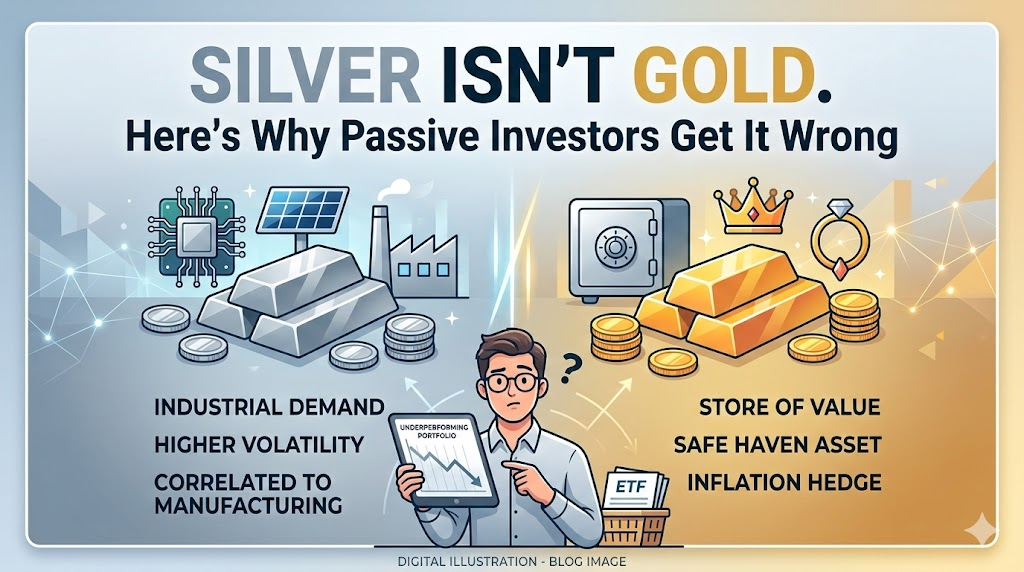
Silver, on the other hand, is also a store of value, but only partially. It has got a larger component of industrial demand, even it’s a precious metal. It combines the store of value as a quality as well as industrial demand. Almost 50% of silver’s global demand comes from industry. 20-25% is jewelry and say only 30 odd percent is actually coming from the investment fraternity. So naturally, the dynamics are different.
Also, because of this industrial demand factor, silver has some level of cyclicality to it. Because economies will function in cycles. There are business cycles. So economic expansion and depression, both these things are, you know, contraction, these things will happen cyclically. And because of that, silver demand is also impacted. So silver is not only store of value, it is also driven by industrial demand.
Another thing is silver market size is not as big as gold. So the supply constraints are more applicable to silver than gold. And that’s why you see higher volatility in silver prices. If you really see, and since we are talking more comparatively to gold, I would say the correlation between gold and silver is pretty positive. If you really see over a long term, over the long term, you will see the prices moving in the similar direction. You will not see sudden, you know, I mean, you will not see a sustained divergence from each other in gold and silver prices.
Now, if in times of economic expansion, you will see that the demand surges. And at the same time, the supply will not surge or it will not increase with the same quantity. And you will see the prices going up.
Okay, so now if we zoom out a little and think about long term asset allocation, what does silver add to a portfolio that equities, gold or fixed income may not fully provide?
Equity, bonds, this is a typical portfolio if we look at, you know, a very, very typical, maybe people have 60-40 kind of portfolios, where 60 in equity, 40 in debt. Gold is a third asset which adds that pitch. Usually, over a period of time, say 20 years, take 20-25 years kind of period, you will see that the correlation between traditional assets and gold is negative. You’ll see when the other asset classes, the traditional asset classes don’t perform, gold performs because that’s the flight of safety kind of phenomenon that happens when people are afraid of certainprevailing risks in the market, they will go to safe haven kind of assets like gold. So silver is somewhere in between these two. So, you know, if you see from an asset allocation perspective, if you ask me, I would say silver is more like an enhancer of returns in the metals or commodities basket.
There is a ratio, which is the most useful, you know, quantitative parameter people use, which is a ratio between gold and silver prices. And this ratio, whenever that ratio deviates too much from its mean, you will see some kind of catching up happening. For example, in the last one or one and a half years’ time, silver has risen way more than gold in this period. So the move in gold is much smaller in terms of percentage. The move in silver, the up move, has become more ferocious. Why did that happen? Because for pretty some, not long time, but I would say midterm, we would say that that gold-silver ratio had deviated too much. So silver was lagging gold for a long time. And now, suddenly, that up move has come and that catching up has happened.
So this is also one of the indicators, and this is a tactical indicator. When something of this sort happens, when you see that, okay, this gold and silver ratio has actually deviated too much on the upside, so you know that, well, that actually means that some correction in silver is imminent or some strong move in gold is imminent. But that ratio is maintained over a period of time.
So from that perspective, if someone wants to include silver in the portfolio, it should be considered as an enhancement of the returns when you have a very clear call on gold and the other factors like the gold-silver ratio are also in your favor. So this is something as an allocation call.
And I would still put one more word of caution for the investors that gold can be considered as a strategic asset class and you can actually hold your gold position for 20-25 years or whatever time you want because this is more like a doomsday insurance, as I mentioned. But silver, you know, allocation to silver is more of a tactical call than strategic call. So one needs to really pay attention to the timing, I mean, not timing in terms of price I am talking about, but in terms of the call on the economy, the call on the industry where silver is in high demand. That kind of tactical decision needs to be taken when one allocates to silver. But not gold is different.
So now, as you mentioned, silver also has a big industrial side to it. How much do global economic trends influence silver prices and how is that different from gold? Now see, silver is basically, you know, an indispensable component when it comes to solar panels, photovoltaics, when it comes to automobile, electronics, EVs, you know, these are the areas, these are the industries where there is a lot of demand and this is mission critical. Silver is mission critical in these things. So silver is the highest conductor of electricity. It is anti-corrosive. So these properties make it quite a unique metal for these industries. And this is mission critical component for these industries.
You know, it’s a very natural phenomenon that we see that when economy expands, these industries will also expand. And when these industries will expand, naturally the silver demand will expand. Right. So cyclicality is also one of the factors here, is also one of the properties of silver. When there is a downturn in economy, you will see that silver demand going down. Solar panels or, you know, these kind of energy related things, they are not exactly cyclical in nature because that is required day to day. Everyone requires electricity. Right. So this is more like a more like a strategic push from governments for energy transition, clean energy. So silver’s elasticity in demand has come down a bit because of the solar industry picking up.However, it is still subject to the economic downturns and economic expansions. So how these things impact prices is pretty straightforward, actually. There is no complication. When economy expands, demand expands, prices go up. But there is one risk I would like to mention here, and that risk is substitution.
Because technology keeps changing, it keeps evolving. Now, what is the best option available for electric conductivity after silver? And that is copper. Copper is more abundant, it’s cheaper, but that difference in the conductivity can create major issues in certain industries. That’s where silver is mission-critical. But other industries where you don’t require that kind of high conductivity, there could be some R&D that is going on and everywhere is going on, actually, how to make it more efficient. So they can actually develop technologies to substitute silver with copper. And that’s how they will bring the prices down, their cost down, the prices down. And that can also impact silver demand. This kind of situation is not applicable to gold, if you really see. So that’s how it also differs. Industrial demand will impact prices more on silver, but less on gold.
Right. So for a passive investor trying to build a well-balanced portfolio, where do you see silver fitting in, if at all? In active investment management, it’s not a trading call for silver, I would definitely say. It’s not a trading call. It can be a tactical allocation, as I mentioned. It’s not trading.
So, I think passive investment, like ETFs in silver, is more convenient for investors because they don’t have to own physical silver. The logistics is a factor which is quite difficult to manage when you actually buy precious metals like this. For retail investors, you can buy silver and put it in your locker or wherever you feel safe. But the tax considerations and the premium that is charged sometimes by the retailers is also pretty, how do I put it, it’s more like a little bit of unregulated territory we go into that. So, the logistical cost, risk, risk of theft, it can be anything. So, all these things can be actually avoided by going into passive investments like ETFs. So, it’s a more convenient and more efficient way of investing in silver. And that’s passive because you don’t have to keep churning that. Anyway, you are not going to churn. You are going to take a tactical call, maybe say one year, two year, three year kind of call, and you will get out probably. So, it’s very easy to buy these instruments on the stock exchange and sell the instruments on the stock exchange without really getting into too much of a logistical hassle.
So, as the name suggests, it is a form of mutual fund which is listed on stock exchanges and traded like a stock. So, in one sentence, you can see that what exactly ETFs are. Now, they are also governed by SEBI like mutual funds.
A couple of important factors about ETFs that I would like to mention is that you can actually take exposure to silver. Right now, we are only talking about silver ETFs. And ETF is a broader instrument. It can be index ETF, it can be gold ETF, it can be silver ETF, etc. So, in silver ETFs, you are actually taking exposure to silver without owning physical silver. ETFs are designed to track the prices of silver.
A passive investor, should they actually look at investing in silver at all? This question has become a nuance because this will directly have a bearing on the investor’s risk appetite.
Right. See, as I… and let me take one step back. When I say risk appetite, I am not talking about volatility. And this is aIt keeps moving up and down. And that’s why you say it’s pretty risky. Well, by risk, what I mean is not volatility. it is the probability of permanent loss of capital. That’s what I would call risk and not volatility. Why? Because if you are talking about a long-term investment, volatility should not bother you. If the price that you are paying for it, you are convinced about that price, then one should definitely look at silver as a component of your portfolio.
Again, this is not a 10-year call like gold because of the factors that we just discussed some time ago. It is more tactical call but that needs to be looked upon as an investment and not a trading instrument. Coming to whether people should include this in the portfolio, that will depend on their risk appetite because people may think that, well, I am taking a two-year call and in two years’ time, silver in history, silver also has seen a bit prolonged downturns. So, two years, three years downturns, silver has seen. So, if that patience is going to run out, then you may end up booking losses. So, that risk appetite is a very, very important factor here to consider first.
If I am fine with taking that risk and that’s why the sizing will matter because nothing is risk-free. If I am taking a 5% exposure to silver in my portfolio, then I should be aware of the risk I am taking because this 5% can come to 2% if my decision goes wrong. And I should be able to sustain that 3% to 3% of loss so that my other portfolio is designed in such a way that it will cover for these losses. So, I will go for something which is in negative correlation with silver and when silver falls, these things will rise and it will actually balance my portfolio.
Anything else that investors should be aware of before they invest in silver ETFs or funds? There is one risk that is of a premium or discount to the NAV. What happens is, if say, there is an ETF that has just come up and it issued 1 lakh units. And then 1 lakh units, when they issued that, they actually bought 1 lakh grams of silver and stored in the vault that they have. Now, because this is listed on stock exchange and it is traded intraday everywhere, the demand for the ETF may, if it is very high, it can create a certain premium to the NAV.
That is the silver price. So, if silver price is 3.5 lakh rupees today, if you convert the equivalent amount of silver into the ETF prices, you may see that it is actually 4 lakh or 4.5 lakh. But what does that mean? There is a 1 lakh rupee premium being charged to the spot silver prices. And this is one risk one has to be aware of. So, the demand for that ETF on exchange will create a certain premium to the spot price of silver and that one needs to consider. So, your entry is not going to be at a silver spot price. If you want to stick to silver spot price, you can buy bullion. You can just buy physical silver. Buy coins or buy bricks or whatever biscuits. But if you want to take that ETF route, then you should be aware that there may be some premium and you need to take that into consideration.
Finally, for someone who does want exposure, how much silver is reasonable and should it be thought of alongside gold or as a separate allocation? It should be actually alongside gold, I would say definitely. Because as I said, it fills a gap between gold and the traditional asset like stocks or traditional asset like bonds or fixed income funds. It will fill the gap. And the gap, there is no gap per se, but whyI am calling it a gap is because silver by nature combines the characteristics of these two different asset classes. It combines the characteristics of these two different asset classes. Stocks are most, I mean, obviously, they are, I mean, primarily driven by the industrial demand because stocks are basically companies that you are partially owning when you own a stock. So the stocks will be driven by the industrial demand, the industrial headwinds or tailwinds.
Gold is negatively correlated traditionally. So when there is uncertainty or when there is a perceived uncertainty in the industry, people will buy more gold to hedge the portfolio. But this is in between. It also gives you, silver also gives you the benefits of a precious metal move. And it will also give you the benefits of industry, particular industry. So yes, there is a place, but that place should not be, it is not to replace any other asset class. It has got its own space here. And that own space is somewhere between the traditional assets and gold. So by nature, by characteristics, by price dynamics, by risk dynamics, silver stands out on its own. And there is a requirement, I mean, there is a place for silver in the portfolio.
However, now, if you ask me about the allocation, I would say conservative allocation should be, you know, I mean, this is a very, very broad ballpark because I am just throwing, one needs to really consider his own appetite to finalize the allocation. But on a conservative basis, it can be just 1 to 3% kind of allocation can be as a ballpark conservative allocation because as I said, and why conservative? Because it’s very volatile, because it’s, it can create some lag on the, or some drag on the portfolio returns if there is a prolonged downturn in silver. That’s why I’m saying for conservative, 1 to 3%.
A moderate risk appetite person can go for around 3 to 5%. And if someone wants to take a higher risk and he has a higher risk appetite and he wants, wants to take a concentrated, tactical, aggressive bet, then it can be anywhere between 5 to 10%.
Well, with that, we’ve reached the end of today’s conversation. Thank you so much, Amol, for joining in and sharing your insights. Thank you very much. Thanks for having me here. Thank you for watching The Index Investor. We’ll continue to break down such questions through a long-term, low-cost investing lens. Keep watching this space for more information. Bye for now.