Hello and welcome to another episode of The Index Investor. Now, Target Maturity Funds are often described as simple, predictable, and well-suited for long-term debt investors. Yet, despite their growing popularity, many investors still struggle to understand how they actually work, how they compare with fixed deposits, and where they really fit in a portfolio.
So in today’s episode, we break down Target Maturity Funds, from how they’re structured to how returns are generated and what risks and tax implications investors should be aware of. Joining me today is Jaideep Doshi. He’s co-founder and CEO of ProInvest Wealth. Welcome, Jaideep.
Hi, thank you, Ruchira. To set the context first, for investors who may be hearing about them for the first time, what exactly is a Target Maturity Fund, and what is the core idea behind how it works till maturity?
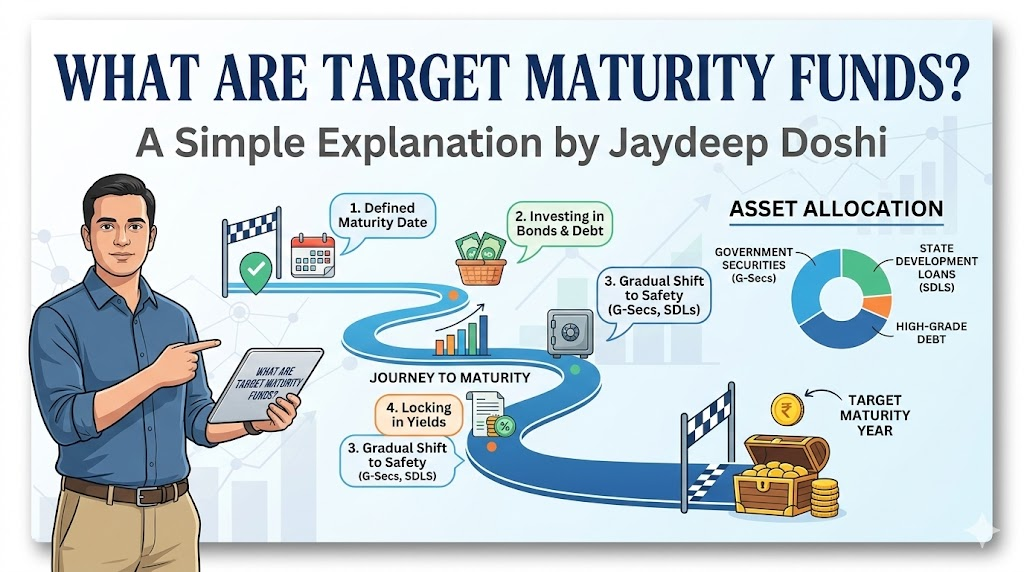
Target Maturity Fund basically is a mutual fund which will buy high-quality assets, high-quality bonds which are highly liquid, and they will hold on till the maturity. So just like, to make it very easy to understand, it’s just like a fixed deposit with a predefined maturity date. Unlike other mutual funds or actively managed funds, this comes under the passive category. So these are passively managed. That means once the bonds are bought and they are held on to the maturity till the end. So that’s the basic understanding about Target Maturity Funds.
So Jaideep, like you mentioned, Target Maturity Funds, they’re often discussed alongside fixed deposits and other debt funds. So from an investor’s perspective, how should they think about a Target Maturity Fund differently, both in terms of how it behaves over time and what ultimately drives returns?
If you just go back to the history of India’s mutual fund industry, they were all open-ended funds, mutual funds, actively managed by fund managers. So typically, there was a gap between understanding the bond markets in India and the retail participation who were used to investing in fixed deposit and getting fixed sum and assured money at the end of the tenure.
But what happened with mutual funds, the investors due to lack of awareness, the investors never understood the risk of interest rates, the risk of liquidity, the credit risk. And that’s where funds like Target Maturity Fund evolved actually. And that’s where they were born way back in 2021.
So the primary complaint of retail individual investors while investing in debt market was that they were never given any assured returns, no predictability of returns. So basically, people never understood that if interest rates go up, bond yields come down. I mean, your price comes down and that’s and vice versa. And there is a huge mark to market risk.
What also primarily people do in debt funds, assuming that the returns are very linear, but if you go back and track the past track record and then invest in the mutual fund, then in the debt fund, then it would give them a negative experience because the interest rates were not static. Every time the interest rate moved, the returns were never predictable. They would either go up more beyond their expectation or go down and even at times see negative returns during extreme situations.
And hence Target Maturity Funds came in and they also and primarily mutual fund industry is also wanting to tap the debt, the fixed deposit markets, you know, for the investors who are coming in. And since this was the issue where it was getting difficult for the investor to understand the get the predictability of the returns and Target Maturity Funds were bought in, they are just like fixed deposits.
So what these fund managers or what the fund houses do is they will buy, let’s say, a government bond for 10 years and they will give you a yield for that bond, which is pretty predictable till the end of the tenure. So if you hold that mutual fund for 10 years, the returns were assured and the fund manager would not buy anything out of his since they are passive, there was no question of active management in this and the returns became predictable.
And this is where they can replicate fixed deposits in Indian markets and fixed deposits, like I said, give predictable returns. So here there were several advantages compared like tax advantage, tax different basically. Initially, there was even tax advantage that way back in 2023, where you investors used to get, you know, indexation benefit if they held the bond for over three or mutual fund for over three years, which they never got in fixed deposits.
Sothey were highly competitive. They also became predictable because fund houses gave very linear, you know, payout charts for them. And it became a very big industry and so started garnering a lot of steam, a lot of money used to come in because retail also got what they actually needed. And only when in post-2023, when the income tax rules got changed and the target maturity funds or any mutual fund debt investment became as good as investing in fixed deposits and the indexation benefits were taken away.
So, but still, I mean, broadly, they are just like fixed deposits. So any investor who has a fixed tenure in mind saying that he needs this money after five years, he should look at any target maturity fund which matures after five years. He would know up ahead what kind of returns he would generate in the next maturity.
Also, the advantage here compared to fixed deposits is that here you pay tax only on redemption or only on maturity and not during the course. Whereas in fixed deposits, even if you take a cumulative fixed deposits, your ID is expected to pay tax based on the accrued interest every year. So this way there is tax different as well as linearity in returns or predictability of returns with good asset qualities. It is pretty simplified. It is as per their tax income tax slab. They pay taxes and only benefit here is the deferral of tax.
One good thing is that they are primarily they are only in government bonds or state bonds and maybe going forward, you know, where there is a lot of encouragement given to investment of municipal corporations to raise funds on their own and list them. So going forward, if such bonds are available, where the credit rating is very high, predictability of return is there.
Also, the other advantage was that the liquidity is too high. So you can get money on tap T plus one money is credited to your account and that’s where they became as competitive as fixed deposit and you know it suited a lot of investors requirements.
So like you mentioned, you can redeem whenever you want to. What about the maturity date? Is there then some penalty on withdrawing earlier or so again, good thing here is that there is absolutely no penalty because they are all highly traded, highly high quality government bonds, which are and in India, the best liquid bond market or best liquid you know bonds, most traded bonds are the government bonds. No other bond gets as well traded as and there is no exit load concept. You can redeem any time after as low as as near as about two months, three months of date of investment.
So, so liquidity, predictability, high quality bonds and tax deferrals. So these are great, you know, it was a great tool for retail participants also who get into mutual fund debt market, passively managed. So again, costs are low. So I mean, these are great things. I mean, one could ever want.
And also in India, if you go and buy bonds directly, you know, it’s not easy and it’s not possible. RBI has been trying to get these direct participation, but it’s not been so successful as much as they had anticipated. And also the understanding of bonds. So if mutual funds manage it and they give liquidity and they give good quality and where there is a good, you know, predictability of return, I think it meets all the criteria as that a retail investor or HNIs or anybody who’s wanting to invest in bond markets in India.
So once an investor is clear that target maturity funds, they fit their needs, how should they think about using these funds within a portfolio? Is there a broad framework or a simple thumb rule for deciding the right level of exposure?
So there is no, I mean, one would obviously I’m assuming that there is some level of asset allocation everybody has and everybody understands which what age group he is currently in and he would have his debt and equity allocation.
So like I said, I would suggest or I would probably, you know, say that investing in target maturity funds or a passive target maturity fund is or a fixed deposit is the same and any allocation that and also if you have near term to long term goals or let’s say five years and forward, I mean, 10 years, 20 years bonds you want to buy.
Because if you go back, you know, now, if I had to retire after 20 years and I wanted, you know, some bond which could fetch me 7% returns, obviously, if the way interest rates and if India is progressing, 20 years hence interest rates would be close to 4% or 3%. And then my retirement requirements wouldn’t get fulfilled.
So if I have the vision and I have the understanding about these goals, then one can easily allocatehis long term debt allocation through the target maturity funds, which offer as long as 30-year bond, which you cannot be replicated in fixed deposits. So anything that is over five years, 10 years, should be considered through target maturity funds. Less than that, you could go to either bank deposits or buy short-term funds, which are actively managed by fund managers.
Right, so whatever you’ve told till now looks really good, but are there any risks also that investors should be aware of, especially the ones that are often overlooked or misunderstood?
Yeah, so yeah, I mean, the biggest risk is the, you know, people not being aware about the interest rate movement. So since they are listed mutual funds and they are daily, NAV has to be declared every day. You know, and if interest rates, so let’s assume that today interest rates are 8%, and tomorrow, due to economic situations, interest rates go up to 9%, and these bonds will face, you will see a mark-to-market loss of, let’s say, and you are at a 10-year target maturity fund, you will have a loss close to 10% on your portfolio. So that probably, you know, so, but if you stay invested for the next 10 years, then there is no risk. You would get the assured returns that were promised to you. But in the meantime, till the time you are holding the bonds, and if you track the schemes or the NAV every day, there is a high possibility that you will get confused or may get misguided because of the mark-to-market gains and losses.
And also here, if also there is a little bit of hindsight bias or people who track past performances, you know. So that is another risk. Other than, you know, these tracking errors and those technical risks, I would like, since this is more towards the investors, this, you know, our conversation is going to help the investors to understand target maturity funds. I would just want to say that if you would go back and if you track any target maturity fund past five years performance, it is the most riskiest thing to do. And, you know, assume that the same will get replicated because interest rates forward-looking judgments are not known to anybody very easily, especially retail investors. So they should avoid looking at past track records of any fund and get into it just based on their past track record or past performance.
And like I said, interest rate risks are always there. If interest rates go up, then you are going to see a mark-to-market loss for the temporary period. And if interest rates go down, you are going to see mark-to-market gains. It can be used very technically, provided you have an understanding or you have an advisor who can give you this, you know, extra bit of knowledge of earning or, you know, getting mark-to-market gains and losses.
But other than that, primarily, there are not too many risks that one should undergo. It’s as good. And also, like I said, they are AAA rated government security bonds, which are better than going fixed deposits in maybe any, you know, small savings scheme or, you know, small bank or anybody, you know. So that way, it’s quite, there are very few things that one has to really be mindful of:
Not following the NAVs in between.
Not going by the past track record.
A little bit of tracking error because the cost that are included in there.
So target mutuality funds, they can be powerful tools when used correctly, but like any investment, they work best when investors understand clearly the risks, the timelines and the tax implications involved.
Thank you, Jaydeep, for joining in and sharing your insights. Thank you. Thank you, Ruchi. Thanks. Thank you.