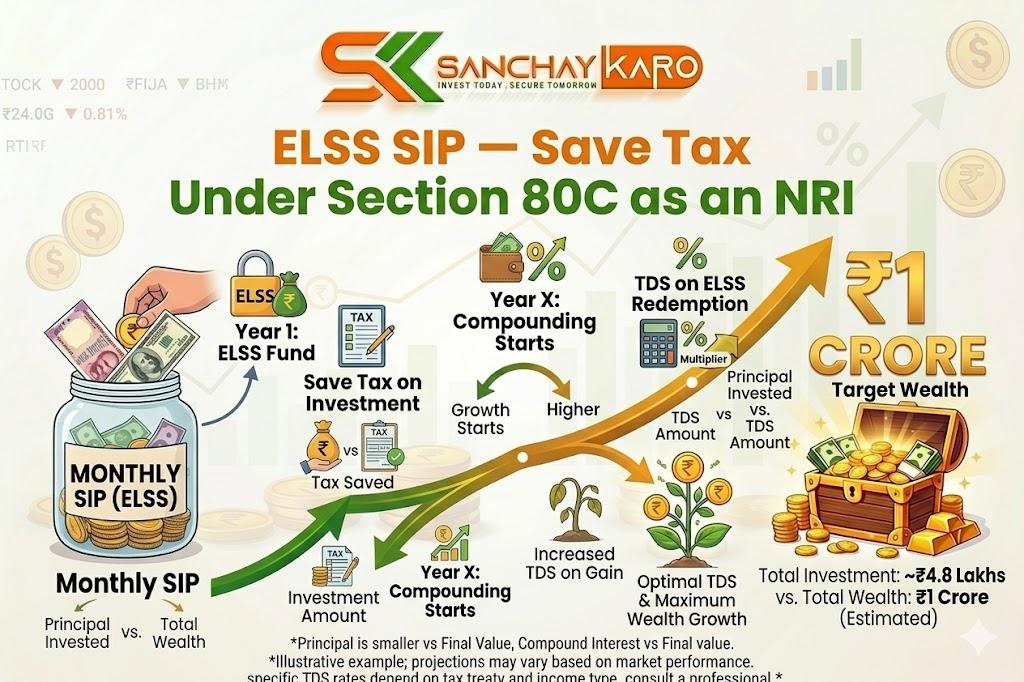
ELSS SIP — Save Tax Under Section 80C as an NRI. Invest ₹1.5 lakh in ELSS SIP and save up to ₹46,800 in taxes.
As an NRI, you work hard for your money. But how much of it are you losing to taxes? If you have taxable income in India — such as rental income from a property, capital gains, or even a pension — you are required to pay tax. However, you also have an opportunity to reduce that tax burden legally and smartly.
Enter ELSS (Equity Linked Savings Scheme) . It is the only mutual fund category in India that offers tax benefits under Section 80C of the Income Tax Act. By investing in an ELSS SIP, you can save up to ₹46,800 in taxes while simultaneously building long-term wealth through equity markets. It is a win‑win.
Let’s break down exactly how it works, how much you can save, and why NRIs should consider this powerful investment vehicle.
How Much Tax Can You Save with ELSS?
Under Section 80C, you can deduct up to ₹1,50,000 from your taxable income every financial year. This deduction is available only if you opt for the old tax regime — the new regime does not allow Section 80C benefits.
If you fall in the 30% tax bracket (income above ₹24 lakh per year), your maximum tax saving would be:
| Calculation | Amount (₹) |
|---|---|
| Maximum Section 80C deduction | 1,50,000 |
| Tax rate (30% slab) + 4% cess | 31.2% |
| Maximum tax saved per year | ₹46,800 |
Now let’s see how a disciplined ELSS SIP grows over its mandatory lock‑in period of 3 years.
Investment scenario: ₹1,50,000 per year (₹12,500 per month) in an ELSS SIP, 12% expected return.
| Time Period | Total Investment (₹) | Estimated Corpus (₹) |
|---|---|---|
| After 3 years | 4,50,000 | 5,40,000 |
Your investment of ₹4.5 lakhs grows to approximately ₹5.4 lakhs in just 3 years — that’s a gain of ₹90,000. Plus, you save up to ₹46,800 in taxes every year. In the first year alone, your effective return on the ₹1.5 lakh investment is nearly 10% from tax savings alone, before accounting for market growth.
Key Features of ELSS for NRIs
1. Tax Benefit Under Section 80C
As an NRI, you are eligible to claim deductions under Section 80C on income earned or accrued in India — such as salary from an Indian employer, rental income from Indian property, capital gains, or business income. This is a significant benefit that many NRIs overlook.
2. Shortest Lock‑in Among Tax‑Saving Options
ELSS has a mandatory lock‑in period of only 3 years — the shortest among all Section 80C investment options. For comparison:
- PPF has a 15‑year lock‑in
- Tax‑saving FDs have a 5‑year lock‑in
- NSC also has a 5‑year lock‑in
With ELSS, your money is not locked away for decades. After 3 years, you can redeem your units, switch to another fund, or continue investing.
3. Market‑Linked Returns with High Growth Potential
ELSS funds invest at least 80% of their corpus in equities — across large‑cap, mid‑cap, and small‑cap companies. Historically, well‑managed ELSS funds have delivered 10‑12% annual returns over long periods. Some funds have even delivered 12.9% CAGR over 20 years.
4. Flexible Investment Options — SIP or Lump Sum
You can invest in ELSS through a lump sum or a Systematic Investment Plan (SIP). For NRIs, the SIP route is often more convenient, as it allows you to start with a small amount and invest regularly from your NRE or NRO account.
5. Each SIP Instalment Has Its Own 3‑Year Lock‑in
If you choose the SIP route, each monthly instalment has its own independent lock‑in period. For example, if you start a monthly SIP in January 2026, the first instalment becomes redeemable in January 2029, the second in February 2029, and so on. This provides a staggered liquidity window.
ELSS vs. Other Tax‑Saving Options for NRIs
| Investment Option | Lock‑in Period | Return Potential | NRI Eligibility |
|---|---|---|---|
| ELSS Mutual Fund | 3 years | 10‑12% (market‑linked) | ✅ Yes (through NRE/NRO) |
| PPF | 15 years | 7‑8% (fixed) | ❌ Cannot open new PPF account |
| Tax‑Saving FD | 5 years | 6‑7% (fixed) | ✅ Yes |
| NSC | 5 years | 7‑7.5% (fixed) | ❌ Cannot make new NSC investments |
| ULIP | 5 years | Market‑linked | ✅ Yes |
For NRIs, ELSS is often the most attractive option because of its short lock‑in, high return potential, and flexible investment options. NRIs can invest in ELSS through their NRE or NRO accounts after completing standard KYC formalities.
Which Account Should You Use — NRE or NRO?
You can invest in ELSS through either an NRE or NRO account. Your choice depends on the source of your funds and your repatriation needs.
- NRE Account (Non‑Resident External): Ideal if you are using overseas income to invest. Funds in an NRE account are fully repatriable — both principal and returns can be sent back to your country of residence without any upper limit. Interest earned is also tax‑free in India.
- NRO Account (Non‑Resident Ordinary): Use this if your investment money comes from Indian income sources (rent, pension, dividends, etc.). With an NRO account, only the capital appreciation (gains) is repatriable; the principal amount remains non‑repatriable.
For most NRIs using foreign earnings to invest in India, an NRE account is the simpler and more flexible choice.
Important Considerations for NRI ELSS Investors
Section 80C Benefit Applies Only to Indian Income
The ₹1.5 lakh deduction under Section 80C is available only on your taxable income in India. If you have no income in India — for example, if all your earnings are from your job abroad — you cannot claim this deduction. However, you can still invest in ELSS for its growth potential.
Old Tax Regime Required
Section 80C deductions are not available under the new tax regime introduced in 2020. If you want to claim this benefit, you must opt for the old tax regime when filing your ITR. The new regime offers lower tax rates but removes most deductions, including 80C.
ELSS Gains Are Taxed as Capital Gains
After the 3‑year lock‑in period, any gains from ELSS are treated as long‑term capital gains (LTCG) . Currently, LTCG up to ₹1.25 lakh per financial year is tax‑free. Gains above this threshold are taxed at 12.5%. This is significantly lower than the 30% tax rate on other income.
KYC and Documentation for NRIs
Before investing in ELSS, NRIs must complete the KYC process. This typically requires:
- PAN card
- Copy of passport and visa
- Overseas address proof
- Recent photograph
- Bank statement
Documents may need to be attested by authorized officials such as an Indian embassy/consulate, a notary public, or an overseas branch of a scheduled Indian bank.
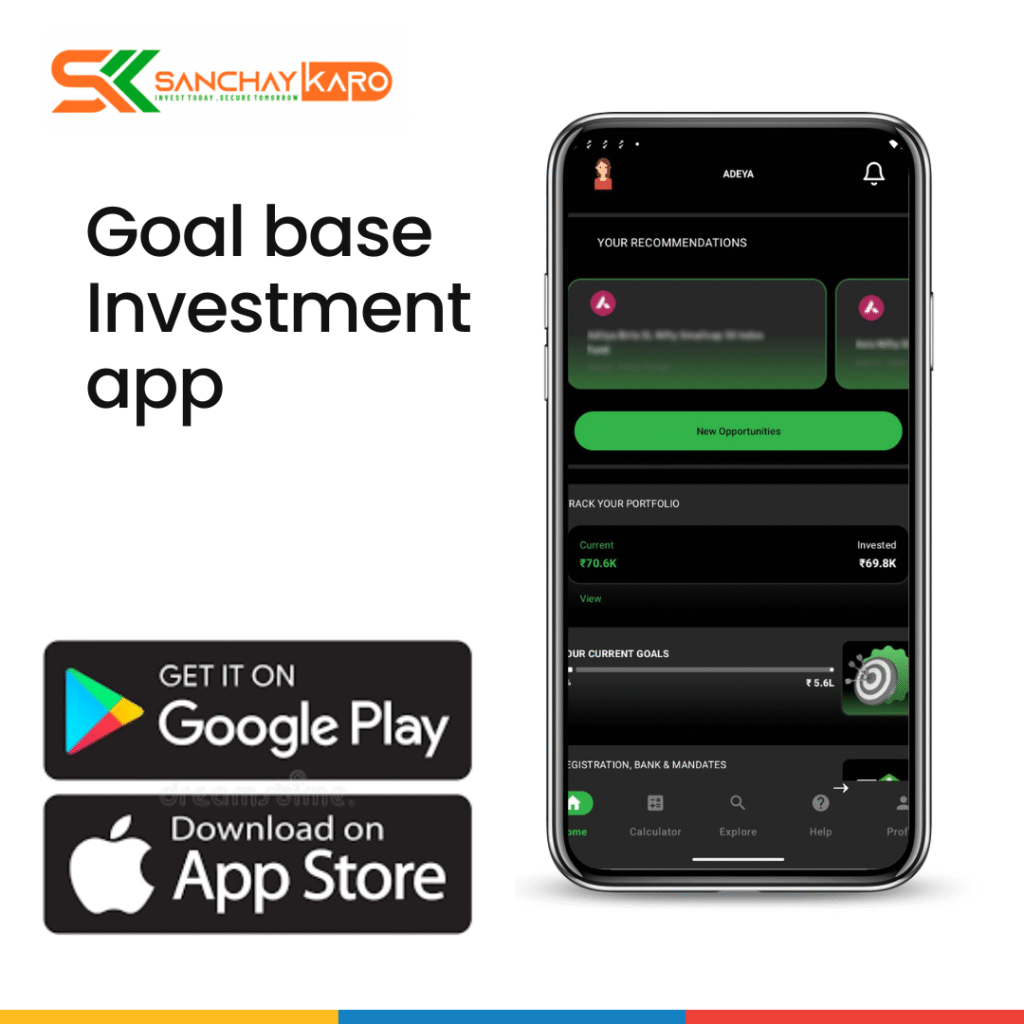
Why Sanchay Karo App is the Ideal Partner for NRI ELSS Investing
The Sanchay Karo Investment App is built to help NRIs navigate Indian investments — including ELSS — with clarity and ease. Here is how we support you:
- Tax‑Saving Goal Calculator: Enter your taxable income and see exactly how much you can save by investing in ELSS under Section 80C.
- Smart ELSS Fund Recommendations: Based on your time horizon (minimum 3 years) and risk profile, the app suggests top‑rated ELSS funds that have historically delivered 12%+ returns.
- SIP Setup from NRE/NRO Account: Link your NRE or NRO account and start an ELSS SIP with as little as ₹500 per month. The app handles the auto‑debit.
- Lock‑in Tracking: The app tracks each SIP instalment and shows you when each one completes its 3‑year lock‑in period — so you know exactly when your money becomes accessible.
- Capital Gains Reporting: Generate detailed reports of your ELSS investments, including purchase history, holding periods, and estimated capital gains — essential for filing your ITR.
- SEBI‑Registered & Secure: Your investments are held with trusted fund houses. The app is fully compliant with RBI and SEBI regulations for NRI investments.
Join Our WhatsApp Community for NRI Tax‑Saving Tips
Have questions about ELSS or Section 80C? Not sure whether to choose the old or new tax regime? Join the Sanchay Karo Investor WhatsApp Group to connect with experts and fellow NRIs. Get weekly tax‑saving tips, market updates, and answers to your specific queries.

👉 Join our WhatsApp group:
https://chat.whatsapp.com/G2Gdsuasv79BJxbGUMdo1u
Start Your ELSS SIP Today
If you have taxable income in India, you are likely paying more tax than necessary. By investing just ₹1.5 lakh per year in an ELSS SIP, you can save up to ₹46,800 in taxes — and watch your money grow to over ₹5.4 lakhs in just 3 years.
The best time to start was yesterday. The second best time is today.
Start your ELSS SIP on Sanchay Karo App and save taxes while building wealth.
- For Android: Download from Google Play
- For iOS: Download from the Apple App Store
👉 Learn more about NRI SIPs: Visit our NRI SIP page
👉 Join our WhatsApp community for daily NRI tax‑saving tips:
https://chat.whatsapp.com/G2Gdsuasv79BJxbGUMdo1u
Let your money grow tax‑efficiently. Download Sanchay Karo and start your ELSS SIP today.