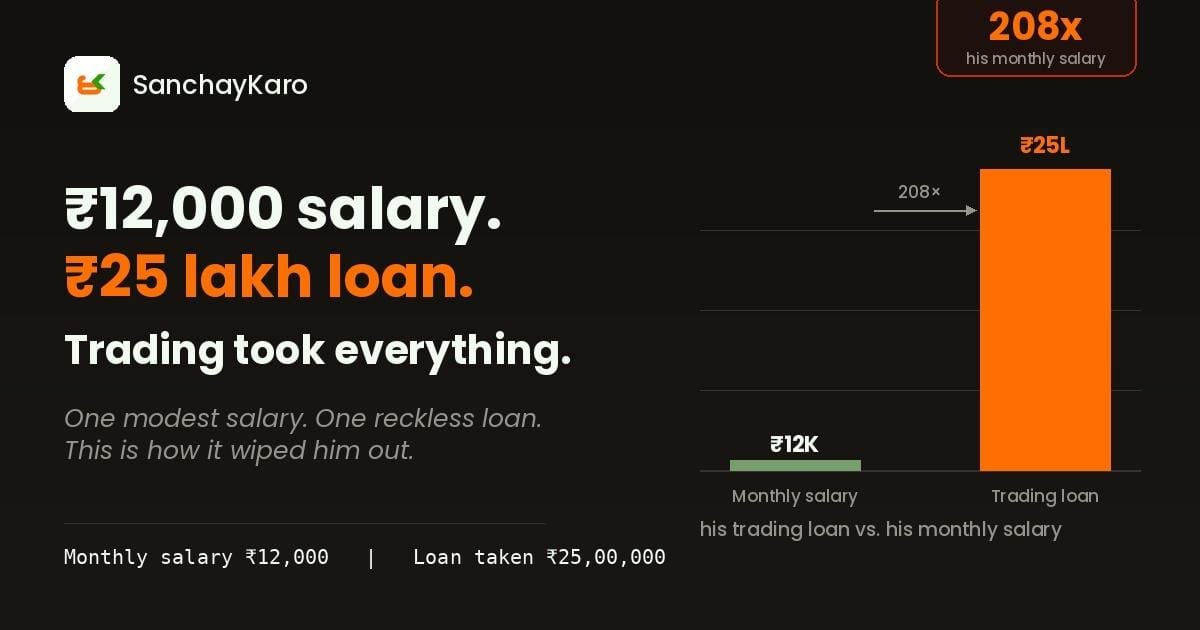
₹12K Salary, ₹25 Lakh Trading Loan | Trading Took Everything From Him
How Trading Turned a Small-Income Dream Into a ₹25 Lakh Debt Trap
Trading is often presented as a shortcut to financial freedom.
A few clicks.
A few charts.
A few successful trades.
And suddenly, a person earning ₹20,000–₹30,000 per month starts imagining a life worth lakhs.
But what happens when those early profits create overconfidence?
What happens when trading stops being an investment activity and becomes an addiction?
And what happens when a person starts using salary, savings, credit cards, loans and borrowed money to continue trading?
The story of Suraj Kumar Batam from Fatehpur, Uttar Pradesh, is a powerful example.
Suraj started trading because he wanted to increase his income and support his family after his father’s death. He began with only ₹5,000.
Initially, he experienced small profits.
Then came bigger profits.
Then greed.
Then losses.
Then borrowing.
And eventually, according to his account in the interview, approximately ₹25 lakh was lost in trading.
But the biggest loss wasn’t only financial.
Trading took control of his life.
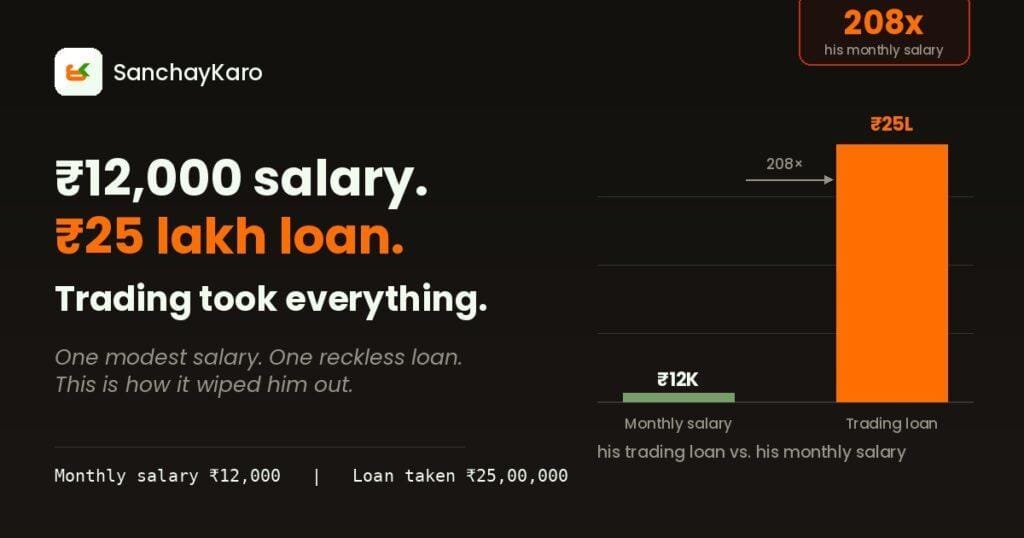
From a ₹12,000 Salary to a ₹25 Lakh Trading Problem
Suraj’s story begins with a simple problem that millions of people can understand:
His income wasn’t enough for his responsibilities.
After his father passed away, the responsibility of his family increased. He had sisters, household responsibilities and financial commitments.
He wanted an additional source of income.
At that time, people around him were trading.
He started watching YouTube videos about the stock market and eventually opened a trading account.
His first investment was only around ₹5,000.
Initially, he lost a small amount.
Then he made ₹100–₹200.
Those small profits created something much more dangerous than a loss:
confidence without sufficient experience.
The First ₹10,000 Profit Changed His Thinking
One of the biggest turning points came when Suraj reportedly made around ₹10,000 in a single day.
For someone earning a relatively small monthly salary, making ₹10,000 in minutes can feel extraordinary.
The thought becomes:
“If I can make ₹10,000 in a day, why should I work for an entire month?”
This is where the psychology of trading can become dangerous.
The goal slowly changes.
It is no longer:
“I want to learn investing.”
It becomes:
“I want to make money quickly.”
And once quick money becomes the objective, risk often increases.
From Equity Trading to F&O and Options
Suraj initially traded in equity.
Later, he discovered Futures & Options (F&O) and options trading.
He started learning about options through YouTube.
Then came another important experience.
He invested around ₹10,000 and reportedly made another ₹10,000 in a short period.
The result was psychologically powerful.
He began comparing trading income with his salary.
If ₹10,000 could be made in a few minutes, why work for weeks to earn the same amount?
This is one of the most dangerous mental traps in trading:
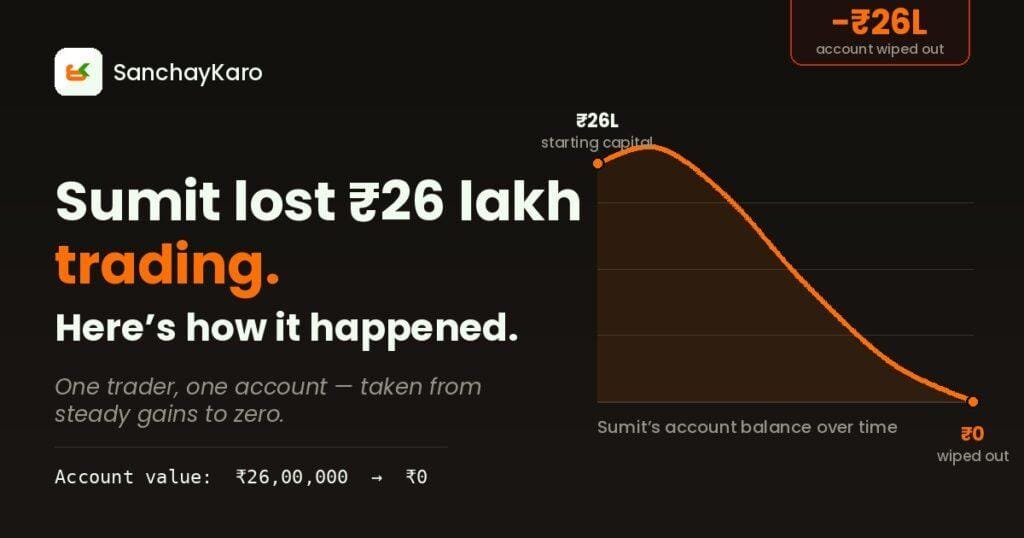
Comparing occasional trading profits with regular salary income.
A salary is predictable.
Trading profits are not.
But after experiencing a large winning trade, the brain often starts treating an exceptional result as if it were normal.
The ₹10,000 Became ₹30,000 — And Then the Risk Increased
Suraj explains that he began increasing his trading capital.
First, he used savings.
Then his salary.
Then money from friends.
Then credit-card borrowing.
The amount of money involved kept increasing.
This is a classic trading loss recovery cycle:
Loss → Need to recover → Bigger trade → Bigger risk → Bigger loss → More money required.
Instead of reducing risk after losing money, the trader increases the amount being traded.
The objective is no longer to make a reasonable return.
The objective becomes:
“I need my money back.”
The Revenge Trading Trap
One of the most important lessons from Suraj’s story is revenge trading.
When a trader loses ₹20,000, the next thought can be:
“I will recover it in the next trade.”
Then another trade is taken.
If another ₹10,000 is lost:
“I will recover ₹30,000 now.”
The position becomes larger.
The emotions become stronger.
And eventually, the trader is no longer following a strategy.
He is trading emotionally.
Suraj describes this feeling himself—after making a loss, he wanted his money back because he had worked hard to earn it.
That emotional connection with the lost money made it difficult to exit.
Why Traders Hold Losing Positions
One of the most important questions in the interview is:
Why do people hold losing trades but quickly book profitable trades?
The answer is largely psychological.
When a trade is profitable, the trader feels good and may book the profit quickly.
But when a trade is losing, the trader starts hoping:
“It will come back.”
A ₹5,000 loss becomes ₹10,000.
Then ₹20,000.
But instead of accepting the loss, the trader continues waiting.
The hope becomes stronger than the trading plan.
This is how a manageable loss can become a devastating loss.
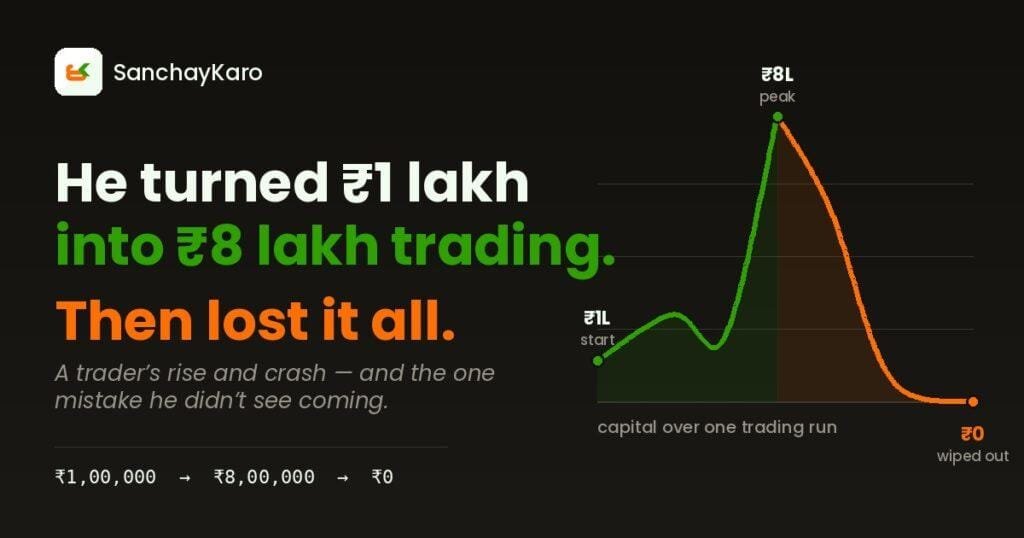
₹70,000 Became ₹3 Lakh — And Then It Started Falling
One of the most dramatic parts of Suraj’s story involves a large trading day.
He describes putting approximately ₹70,000 into trading and eventually making significant profits.
At one point, his account reportedly reached around ₹3 lakh.
Imagine what that feels like for someone with a modest monthly income.
₹70,000 becoming around ₹3 lakh can create enormous confidence.
The trader starts thinking:
“I have figured it out.”
But that confidence can quickly turn into overconfidence.
Instead of withdrawing the money, the trader continues trading.
Then the market reverses.
The profit starts disappearing.
₹3 lakh becomes ₹2.2 lakh.
Then another trade is taken.
The loss increases.
Eventually, a huge portion of the money disappears.
The Biggest Problem Wasn’t the Market
It would be easy to say:
“The market took his money.”
But that isn’t the complete lesson.
Markets don’t force someone to:
- trade with borrowed money,
- increase position size,
- ignore losses,
- take hundreds of trades,
- use credit-card money,
- chase previous losses,
- or continue trading after deciding to stop.
The deeper problem was loss of control.
Suraj himself describes deciding repeatedly that a particular trade would be his last.
But then another trade happened.
And another.
And another.
That is why his story isn’t simply about a ₹25 lakh trading loss.
It is about how trading can become compulsive when money, emotion and hope become connected.
More Than 100 Trades and Huge Brokerage Costs
Another striking part of the story is the number of transactions.
Suraj says that there were days when he made more than 100 transactions.
At one point, he realized that a significant amount was being consumed by brokerage and trading costs.
This highlights another reality of active trading:
Even when individual trades appear small, repeated transactions can create substantial costs.
A trader might focus on:
“I made ₹500.”
But forget:
- brokerage,
- taxes,
- exchange charges,
- GST,
- slippage,
- repeated losses,
- and the cumulative cost of excessive trading.
Over hundreds of trades, these costs can become significant.
From Savings to Salary to Credit Cards
The progression in Suraj’s story is particularly important.
He didn’t start with ₹25 lakh.
He started with ₹5,000.
Then the cycle expanded.
Stage 1: Small Capital
He started trading with a small amount.
Stage 2: Early Profits
Profits created confidence.
Stage 3: Bigger Capital
He began investing more of his savings.
Stage 4: Salary
His monthly income started going into trading.
Stage 5: Friends’ Money
He borrowed from people he knew.
Stage 6: Credit Card
He used credit-card funds and converted borrowed money into trading capital.
Stage 7: Debt
The trading losses continued while the financial obligations remained.
This is how a small trading activity can become a major personal-finance problem.
₹25,000–₹30,000 Income vs ₹60,000–₹70,000 Monthly Payments
At the beginning of the story, one of the most frightening observations is the mismatch between income and financial obligations.
Imagine earning approximately:
₹25,000–₹30,000 per month
while having obligations of approximately:
₹60,000–₹70,000 per month.
That is mathematically unsustainable.
No amount of positive thinking can solve a cash-flow problem of this size.
When debt repayments become larger than income, the person needs a financial recovery plan—not another risky trade.
Family Pressure Made the Situation Worse
Suraj also describes the emotional pressure at home.
His mother repeatedly told him to stop trading.
But stopping wasn’t easy.
There was already money lost.
There were debts.
There were responsibilities.
And there was the belief that another profitable trade could solve everything.
This creates a dangerous loop:
Debt → Stress → Trading → Loss → More Debt → More Stress → More Trading.
The trader starts believing that trading is the solution to the financial problem created by trading itself.
The “One Last Trade” Mentality
Perhaps the most important line from this story is the idea:
“This will be my last trade.”
Many people trapped in excessive trading say something similar.
They promise themselves:
“I will recover this amount and then stop.”
But the market doesn’t know about that promise.
There is no guarantee that the next trade will recover the previous loss.
In fact, increasing the size of the next trade because of a previous loss can make the situation significantly worse.
Why Early Profits Can Be More Dangerous Than Early Losses
This story also teaches an unusual lesson.
A beginner who immediately loses money may stop.
But a beginner who makes ₹10,000, ₹20,000 or ₹50,000 quickly may become convinced that trading is easy.
That early success can create:
- overconfidence,
- unrealistic expectations,
- larger positions,
- excessive frequency,
- leverage,
- and eventually debt.
This is why early trading success doesn’t necessarily mean trading skill.
Sometimes it simply means the trader got favorable market conditions.
The Dream of Making Money Quickly
Suraj wanted money quickly because he had responsibilities.
He wanted a better life.
He wanted to buy a car.
He wanted financial stability.
These goals aren’t wrong.
The problem was trying to achieve long-term financial goals through increasingly risky short-term trading.
The market became a shortcut.
And shortcuts become dangerous when someone is desperate to reach the destination quickly.
Trading Is Not a Guaranteed Second Income
One of the biggest lessons from this story is that people should not automatically consider trading a second source of income.
A second income source should ideally improve financial stability.
If the activity can potentially destroy your emergency savings, salary and borrowed money, it isn’t functioning as a stable second income.
There is a huge difference between:
Investing ₹5,000 that you can afford to lose
and
borrowing ₹5 lakh to recover previous trading losses.
The second situation can become financially devastating.
What New Traders Can Learn From Suraj’s ₹25 Lakh Loss
Suraj’s story contains several important lessons for anyone considering stock-market trading.
1. Don’t Trade With Borrowed Money
Never assume that a future profit will repay today’s loan.
Debt has a fixed obligation.
Trading returns don’t.
2. Don’t Use Credit Cards for Trading
Credit-card money is borrowed money.
Using it for speculative trading can turn market losses into expensive debt.
3. Don’t Chase Losses
A ₹10,000 loss does not create an obligation to make ₹10,000 in the next trade.
Accepting a loss is part of risk management.
4. Don’t Increase Position Size Because You Lost
Bigger trades don’t guarantee faster recovery.
They can accelerate the losses.
5. Don’t Confuse One Big Profit With Skill
Making ₹50,000 once doesn’t prove that a strategy is consistently profitable.
Consistency matters more than a single winning day.
6. Track Every Cost
Trading isn’t just about profit and loss.
Include all transaction costs and taxes when evaluating performance.
7. Protect Your Salary
Your salary is the foundation of your financial life.
Using your entire monthly income to chase trading losses can destroy that foundation.
8. Have a Stop-Loss—And Follow It
A stop-loss that is ignored isn’t a risk-management system.
9. Know When to Stop
Sometimes the best trading decision is not to trade.
The Bigger Question: What If the ₹25 Lakh Had Been Invested Instead?
This is where the story becomes particularly relevant to long-term investors.
Imagine if the same financial discipline had been directed toward:
- systematic investment,
- diversified mutual funds,
- long-term equity investing,
- emergency savings,
- insurance,
- debt reduction,
- and skill development.
There would be no guarantee of returns.
But the approach would focus on consistency instead of chasing quick profits.
Long-term wealth generally isn’t built by trying to double money every few days.
It is built through:
Income + Saving + Investing + Time + Discipline.
Trading Took Everything From Him—But His Story Can Save Someone Else
Suraj’s story is painful because he didn’t start with a huge amount of money.
He started with a small dream:
“I need some extra income for my family.”
The first few profitable trades made that dream appear achievable.
But slowly, the goal changed from earning extra income to recovering losses.
Then from recovering losses to borrowing money.
And finally, trading became something he couldn’t easily stop.
That transformation is the real warning.
A Different Approach to Wealth Creation
The stock market itself isn’t the enemy.
The problem is the belief that the stock market can provide quick, guaranteed wealth.
For most ordinary families, financial progress can be more sustainable when the focus is on:
Regular Saving → SIP → Long-Term Investment → Compounding → Financial Discipline
rather than:
Borrow Money → Trade → Lose → Borrow More → Trade Again.
A disciplined SIP may look boring compared with an option trade that doubles in minutes.
But wealth creation doesn’t need to be exciting.
It needs to be sustainable.
₹25 Lakh Loss Should Be a Lesson, Not Just a Number
₹25 lakh isn’t just a number.
For a person earning a modest salary, it can represent:
- years of income,
- family savings,
- financial security,
- future investments,
- and peace of mind.
The purpose of sharing stories like Suraj’s isn’t to say that everyone who enters the market will lose money.
The purpose is to show what can happen when greed, leverage, debt and emotional trading replace discipline.
Final Lesson: Don’t Let Trading Become Your Life
The most powerful part of Suraj’s story isn’t that he lost ₹25 lakh.
It’s that even after losing such a large amount, he still struggled to walk away.
That should make every new trader stop and think.
Before entering a trade, ask:
Can I afford to lose this money?
Am I using borrowed money?
Am I trading because I have a strategy—or because I want to recover yesterday’s loss?
Would I still take this trade if I had no previous loss to recover?
And most importantly:
If trading is destroying my financial life, why am I still trading?
Sometimes the smartest financial decision isn’t finding the next winning trade.
It is knowing when to stop.
Watch the Full Story
This powerful Bazaar Ke Haare episode tells Suraj Kumar Batam’s story of going from a modest salary and a small trading account to approximately ₹25 lakh in trading losses and debt.
🎥 Watch the full video:
₹12K Salary, ₹25 Lakh Trading Loan | Trading Took Everything From Him