₹18 Lakh Loan for Brother’s MBBS — He Burned It in Trading
₹18 Lakh Loan for Brother’s MBBS — He Burned It in Trading | Anurag’s Trading Loss Story
What happens when someone starts earning money at a young age, builds savings quickly and begins believing that everything they touch will turn into gold?
This is the story of Anurag from Delhi, whose journey from freelancing and saving money eventually moved into penny stocks, options trading, Telegram tips and increasingly risky decisions.
According to the supplied interview, Anurag accumulated approximately ₹20–25 lakh in savings through his work. But after returning to the market, a combination of greed, overconfidence, missed profits, options losses and revenge trading changed his financial situation dramatically.
The headline of the episode refers to an ₹18 lakh loan connected with his brother’s MBBS education, while the supplied transcript section describes approximately ₹15 lakh of trading losses at one stage. Because the transcript contains multiple amounts and stages of the story, this article presents them as described in the interview rather than treating every figure as independently verified.
This isn’t simply a story about losing money.
It is a story about what can happen when financial success creates overconfidence—and when the desire to make more money becomes stronger than the discipline to protect what you already have.
Watch the full Bazaar Ke Haare episode on YouTube
Anurag Started With Freelancing, Not Trading
Anurag says he was introduced to the stock market around the age of 19.
After completing Class 12 in 2021, he did not immediately have a clear career plan.
Instead, he started freelancing and learned graphic designing.
He worked for clients, including clients from the US, and gradually built his savings.
Within roughly a year and a half, he says his savings had reached around ₹20–25 lakh.
That achievement was important.
He had demonstrated that he could earn money through his own skills.
But eventually, another thought entered his mind:
“If I can make money from my work, maybe I can make even more from the stock market.”
That became the beginning of a very different journey.
His First Stock Investment Was Only ₹700
When Anurag initially entered the market, he says he didn’t understand the difference between regular investing and derivatives.
He simply understood the basic concept:
Buy a share. If it rises, you make money. If it falls, you lose money.
His first stock purchase was reportedly around ₹700 in Dhanlaxmi Bank.
He made a small gain and started exploring further.
Then he discovered something much more exciting.
Penny stocks.
He noticed stocks moving 20% or more and began thinking about what could happen if larger amounts of money were invested.
The mathematics looked attractive.
₹100 becomes ₹120.
₹1,000 becomes ₹1,200.
And if the move continues, the imagination becomes much bigger.
This is where the psychological attraction of penny stocks began.
The Penny Stock Trap
Anurag says he started putting money into penny stocks after seeing them repeatedly appear among the top gainers.
Some of the stocks appeared to rise every day.
Later, he says he learned that some were associated with pump-and-dump activity.
But even before understanding the risks, he was attracted by the possibility of quick profits.
He describes seeing YouTube content and advertisements promoting particular stocks, sometimes with claims about future orders, targets and growth.
One stock he discusses in the interview was Arma Fashion.
He says he invested in it after seeing promotional content.
Instead of rising, the stock began falling.
₹80,000 Became a ₹60,000 Loss
Anurag says he initially tried to follow the idea of “buying the dips.”
When the price fell, he bought more.
He expected that eventually the stock would recover.
But according to his account, it continued falling and repeatedly hit lower circuits.
He eventually says he had invested approximately ₹80,000, resulting in a loss of around ₹60,000.
This was an important early warning.
He already knew that the promotional material might not be trustworthy.
He already understood that something could go wrong.
But he says he was greedy and wanted to see what would happen.
That sentence reveals one of the central themes of his story:
Sometimes the problem isn’t a lack of information.
Sometimes the problem is refusing to act on the information you already have.
“I Knew It Could Be Fraud, But I Was Greedy”
During the interview, Anurag acknowledges that he had doubts about some penny-stock promotions.
He knew there was a possibility that they were fraudulent or misleading.
Yet he invested anyway.
Why?
He identifies greed and stubbornness as important factors.
This is a powerful lesson for investors.
Knowing that something is risky does not protect you if you deliberately ignore the risk.
You can know:
- The stock may be manipulated.
- The information may be promotional.
- The price may fall.
- You may lose money.
And still press Buy.
He Took a Break From Trading
After the penny-stock loss, Anurag says he deleted his broker application.
The loss affected his ability to concentrate on work.
His productivity dropped significantly for a period.
Eventually, he returned his attention to freelancing and continued working.
For about a year and a half, he stayed away from active trading.
At that point, the story could have ended differently.
He was earning.
He was saving.
He had already experienced a major market loss.
But social media later brought the market back into his attention.
Instagram Luxury Videos Brought the Market Back
After Diwali in 2023, Anurag says he began seeing Instagram videos showing luxury lifestyles.
Rented Lamborghinis.
Dubai.
Motivational music.
The message was subtle:
Trading and investing can make you rich.
At the same time, his uncle had built a portfolio during the COVID-era market crash.
Anurag says the portfolio had generated very large gains.
This strongly influenced him.
He began thinking about returning to the market.
And this time, he had something much bigger than his original ₹1 lakh savings.
He says he had accumulated approximately ₹20–25 lakh.
The ₹5 Lakh Adani Investment
Anurag’s uncle reportedly suggested investing in a particular stock after a major negative news event involving the Adani Group.
The uncle advised him not to invest too much.
According to the transcript, the suggestion was around ₹50,000–₹60,000.
But Anurag says he invested approximately ₹5 lakh.
The next day, the investment reportedly gained around 13%.
That meant approximately ₹70,000–₹75,000 of profit.
And suddenly, something changed.
The market appeared to validate him.
He had invested ₹5 lakh.
He made a significant return quickly.
He then made further profits from delivery stocks, which he says reached around ₹2–2.5 lakh within a month.
Instead of seeing these profits as fortunate outcomes within a risky market, his confidence increased.
The Dangerous Thought: “Whatever I Touch Turns Into Gold”
Anurag explains that after experiencing rapid career growth and successful investments, he developed a mindset that whatever he touched could become successful.
He describes this as greed and stubbornness, combined with the confidence created by his earlier success.
This is one of the most dangerous psychological traps in investing.
Success can teach the wrong lesson.
Instead of:
“I was fortunate and should remain disciplined.”
The mind can start thinking:
“I am good at this.”
Then:
“I understand the market.”
And finally:
“I can’t lose.”
That’s when position sizes can become much larger.
From Investing to Options Trading
After making money from delivery investments, Anurag says he became interested in options.
His uncle explained the basic idea of calls and puts.
Anurag began trading Nifty and Bank Nifty.
Then came a lesson he says he learned the hard way:
An option can become almost worthless.
He describes buying a far out-of-the-money Nifty call option on expiry day.
He put approximately ₹50,000 into the position.
The option eventually fell to almost zero, resulting in an approximately 99.99% loss on the position.
For someone who had mainly experienced delivery investing, this was a completely different type of risk.
The ₹50,000 Options Loss
Anurag says he didn’t initially understand concepts such as:
- Delta
- Out-of-the-money options
- Expiry risk
- Position sizing
He simply believed that if the market moved strongly, a cheap option could rise dramatically.
That belief can be extremely attractive.
A ₹2 option can look inexpensive.
But the low price does not mean the risk is low.
The entire premium can disappear.
And that is what Anurag says happened.
He Knew Telegram Tips Were Risky—But Joined Anyway
After the options loss, Anurag says he became interested in Telegram advisory groups.
Interestingly, he already had doubts.
He knew that many trading tips could be fraudulent.
But he reasoned that if a group claimed to be registered or certified, perhaps it was more reliable.
He even tested some calls through a paper-trading account.
According to his account, the paper trades appeared extremely profitable.
That gave him confidence.
But paper results and real-money results can create very different psychological experiences.
With real money, emotions enter the equation.
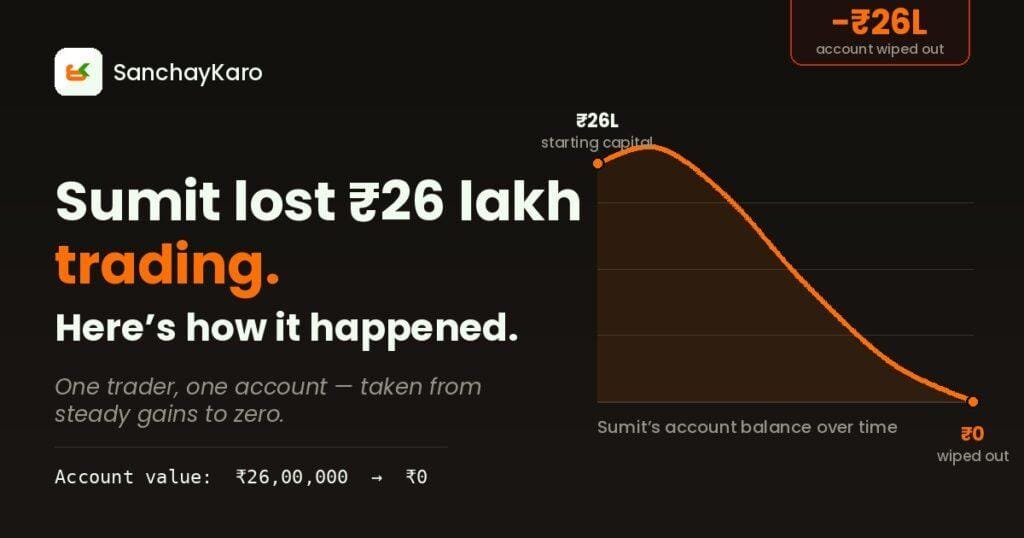
₹5 Lakh Capital and ₹40,000–₹50,000 Daily Profits
Anurag says he eventually deployed around ₹5 lakh in a trading account.
He began receiving stock-option tips.
According to his account, there were periods when he made approximately ₹40,000–₹50,000 per day.
This was another major turning point.
He was no longer thinking:
“Can I make money?”
He was starting to think:
“How much more can I make?”
And that is where overconfidence became increasingly dangerous.
The Stop-Loss Mistake
The advisory calls included stop-loss levels.
But Anurag says he did not consistently follow them.
When a stop-loss was hit, he would sometimes remain in the position.
Later, the trade might recover and reach its target.
That created a terrible lesson:
Ignoring risk controls appeared to work.
He says this eventually became a bad habit.
This is a classic reinforcement problem.
If breaking a rule produces a profitable outcome, the brain may start believing that the rule was unnecessary.
But one lucky recovery does not make a bad risk-management decision good.
January 7, 2024: The Wipro Options Trade
Then came one of the most important trades in Anurag’s story.
On January 7, 2024, according to the interview, he received a Wipro call-option tip.
The option was around ₹27.
The suggested target was approximately ₹48–₹50, with a stop-loss around ₹26.
He initially invested around ₹1 lakh.
When the stop-loss was hit, he became angry.
Instead of accepting the loss, he decided:
“I won’t use a stop-loss.”
That decision changed the position dramatically.
The Position Became Enormous
The price continued moving against him.
Instead of exiting, he kept buying.
The option price moved from around ₹30 down toward ₹4.
According to the transcript, his position eventually reached approximately 78,000 quantities, with an average price around ₹7.5.
His total exposure was roughly ₹5–5.5 lakh.
This was dramatically larger than the positions he had taken earlier.
Why did he continue?
Overconfidence.
He believed the trade would eventually recover.
He had already seen trades fall and then recover.
So he expected the same thing to happen again.
The Loss Became a Psychological Shock
For several days, the option continued falling.
Anurag says he watched it every day, hoping it would recover.
Eventually, the position had lost around ₹3–3.5 lakh at one stage.
He contacted his uncle, who advised him to exit.
Anurag eventually closed the position with a smaller loss of roughly ₹1.5–₹1.7 lakh, according to his account.
Then came the painful part.
The Next Day, the Missed Profit Was Huge
The following Monday, Wipro reportedly opened sharply higher.
The call option rose dramatically, reaching around ₹65 according to the interview.
Anurag calculated that if he had held the position, the potential profit could have been approximately ₹50 lakh.
This created a devastating psychological effect.
He wasn’t only thinking about the money he lost.
He was thinking about the money he could have made.
That distinction is crucial.
The “Missed ₹50 Lakh” Became More Dangerous Than the Loss
Imagine losing ₹1.7 lakh.
That is painful.
But then imagine watching the same position later become capable of generating a potential ₹50 lakh profit.
The mind starts asking:
“Why did I exit?”
“Why didn’t I hold?”
“Why didn’t I trust myself?”
“Next time I won’t make that mistake.”
And that last thought can lead directly to revenge trading.
Anurag says he spent days imagining what he could have purchased with the missed profit—real estate, a luxury car, an expensive watch and other goals.
The missed opportunity became emotionally bigger than the original loss.
This Is How Revenge Trading Begins
Revenge trading is not always about anger toward another person.
Sometimes it is anger toward yourself.
You think:
“I should have made that money.”
Then:
“I will make it back in the next trade.”
Then the position size increases.
Risk increases.
Decision-making becomes emotional.
And the trader stops asking:
“Is this a good trade?”
Instead, the question becomes:
“Can this trade give me back what I missed?”
That is an extremely dangerous transition.
The Biggest Problem Was Overconfidence
Anurag’s story is particularly interesting because he says he understood many of the risks.
He knew penny-stock promotions could be questionable.
He knew some tips could be unreliable.
He knew options could go to zero.
He knew stop-losses were important.
Yet he continued making increasingly aggressive decisions.
Why?
According to his own explanation:
Greed.
Stubbornness.
Overconfidence.
And the belief that his earlier success could be repeated.
The interview’s opening itself summarizes the theme: the problem was not simply that he didn’t know anything; it was that knowledge did not automatically produce self-control.
What Can We Learn From Anurag’s Trading Loss Story?
1. Making money quickly can be dangerous
A sudden profit can create confidence before a person has developed the experience required to manage risk.
2. Penny stocks require extreme caution
A stock appearing among the biggest gainers does not automatically mean it is a good investment.
Research matters.
3. Never ignore a risk simply because you know about it
Anurag knew some promotions might be fraudulent.
He invested anyway.
Knowing the risk and respecting the risk are two different things.
4. Don’t confuse investing with options trading
Buying shares for long-term investment and trading short-dated options involve very different risk characteristics.
Understanding the difference is essential.
5. Cheap options are not necessarily low-risk
A ₹2 option can look affordable.
But the entire premium can disappear.
6. Never let a missed profit control your next trade
The ₹50 lakh potential profit he missed became emotionally powerful.
But missed profit is not a financial loss.
It is money you never owned.
7. Borrowed money changes the equation
When money is borrowed for a financial decision, the pressure to make profits can become much greater.
Using borrowed money to recover previous losses can create a dangerous cycle.
8. Overconfidence can be more dangerous than lack of knowledge
You can study the market for years and still make one emotionally driven decision that causes significant damage.
The Difference Between Wealth and Fast Money
Anurag’s story also demonstrates an important distinction:
Earning money is not the same as building wealth.
He had built substantial savings through freelancing.
That was real progress.
But once he started believing that the market could multiply his money much faster, the focus shifted from protecting accumulated wealth to maximizing returns.
That’s where risk increased.
Wealth creation generally requires patience.
Fast-money thinking often creates pressure for fast results.
Why Sanchay Karo Focuses Only on Mutual Fund Investment
This is exactly why Sanchay Karo follows a different philosophy.
Sanchay Karo does not promote the idea of making money through constant trading.
It does not focus on:
- Daily trading profits
- Expiry-day speculation
- Telegram calls
- Penny-stock tips
- Revenge trading
- Recovering losses through bigger bets
- Borrowing money to invest aggressively
Instead, the focus is:
Save. Invest. Stay Consistent. Grow.
Sanchay Karo focuses only on mutual fund investment, with the broader objective of encouraging disciplined, long-term investing.
The question changes from:
“How much can I make today?”
to:
“How consistently can I invest for my future?”
SIP: A More Disciplined Approach
A Systematic Investment Plan (SIP) allows an investor to invest a predetermined amount at regular intervals.
Instead of constantly trying to predict the next market move, the investor can focus on maintaining a consistent investment habit.
The principles are simple:
Save regularly.
Invest systematically.
Stay patient.
Think long term.
Avoid unnecessary leverage.
Don’t chase losses.
Don’t allow greed to control financial decisions.
Mutual funds are market-linked investments and are not guaranteed to generate returns. Investors should understand the risks and select investments according to their financial objectives and risk tolerance.
Don’t Burn Tomorrow’s Money Trying to Get Rich Today
The most important lesson from Anurag’s story is not that every trader will lose money.
The lesson is that risk can grow silently.
It can start with ₹700.
Then ₹10,000.
Then ₹80,000.
Then ₹5 lakh.
Then a much larger position.
And eventually, borrowed money can enter the picture.
By the time the person realizes how large the risk has become, reversing the damage can be extremely difficult.
Final Lesson: Protect What You Already Have
Anurag had something many young people dream of.
He had developed a skill.
He was earning.
He had built significant savings.
He had financial goals.
But the desire to make more money faster changed his approach.
The market offered opportunities, but it also offered losses.
And after a few successful trades, confidence turned into overconfidence.
The most important lesson is therefore:
Don’t risk your financial foundation just because the market shows you the possibility of becoming rich quickly.
A missed ₹50 lakh profit is not a ₹50 lakh loss.
A ₹5,000 profit does not mean you can make ₹50,000 every day.
And one successful trade does not prove that you have mastered the market.
Protect your capital. Respect risk. Don’t chase losses.
Because building wealth is a long journey.
You don’t need to become rich overnight.
You need to avoid destroying the progress you have already made.
Sanchay Karo — Save. Invest. Stay Consistent. Grow.
The philosophy is simple:
Save. Invest. Stay Consistent. Grow.
Instead of chasing the next big trade, build a long-term investment habit.
Instead of trying to recover yesterday’s loss today, focus on tomorrow’s financial goals.
Instead of risking everything for a quick return, prioritize financial discipline.
Small, consistent steps can be more valuable than one high-risk attempt to become rich quickly.
Watch the Full Story
Watch the full “₹18 Lakh Loan For Brother’s MBBS | He Burned It In Trading” episode on YouTube
Disclaimer
This article is an editorial adaptation of the supplied “₹18 Lakh Loan For Brother’s MBBS | He Burned It In Trading” interview/transcript. Statements concerning Anurag’s savings, investments, trading activity, losses, loans, Telegram advisories, potential profits, family finances and personal experiences are presented as described in the source and have not been independently verified. The transcript itself contains different amounts at different stages of the story, so figures such as the ₹18 lakh loan, ₹15 lakh loss and potential ₹50 lakh profit should be understood in the context of the interview rather than as independently verified financial records.
This article is for financial awareness and educational purposes only and is not financial advice. Trading, derivatives, penny stocks and other market activities involve substantial risk, and losses can be significant.
Mutual funds are also subject to market risks. Investors should read scheme-related documents carefully and consider their financial goals, investment horizon and risk tolerance before investing.
Sanchay Karo’s philosophy: Save. Invest. Stay Consistent. Grow.