What is a Credit Risk Fund? – Complete Simple Guide for Beginners (2026)
Are you looking for a debt mutual fund that gives higher returns than a bank fixed deposit? A Credit Risk Fund could be the right choice for you. This blog explains what is a Credit Risk Fund in very simple language. You will also learn how to invest easily using the Sanchaay Karo app.
What is a Credit Risk Fund? (Very Simple Definition)
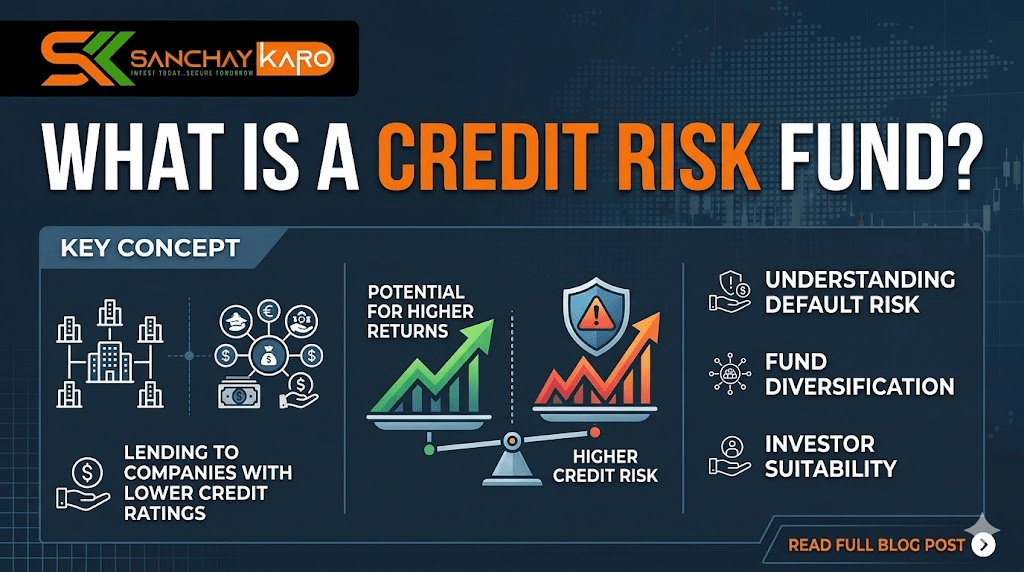
A Credit Risk Fund is a type of debt mutual fund that invests most of its money in bonds issued by companies with lower credit ratings. According to SEBI rules, a Credit Risk Fund must invest at least 65% of its total assets in corporate bonds rated AA and below (that is, AA+, AA, AA–, A+, A, A–, BBB+, BBB, BBB–, and so on).
Think of it like this: When you put money in a bank fixed deposit, you lend to one bank. A Corporate Bond Fund lends only to the safest, top-rated companies. A Credit Risk Fund, on the other hand, lends to many companies that are less established but offer higher interest rates to attract investors.
Companies with lower credit ratings pay higher interest because they carry a higher chance of default compared to top-rated companies. Credit Risk Funds take this additional risk in exchange for the potential of higher returns.
As the name suggests, credit risk is the chance that the money lent out by the mutual fund is not paid back by the borrower. Credit Risk Funds are the only debt fund category that openly spells out this risk in its name.
Important: A Credit Risk Fund is a debt mutual fund, not an equity fund. It does NOT invest in company stocks. It lends money to companies and earns regular interest income. The risk is higher than other debt funds but still much lower than equity funds.
As of 2026, Credit Risk Funds are a well-established category. According to SEBI’s February 2026 circular, these funds now have a clearer risk positioning—Credit Risk Funds are meant to have meaningful lower-rated exposure, while Corporate Bond Funds are for predominantly higher-rated papers.
How Does a Credit Risk Fund Work? (Step-by-Step)
Credit Risk Funds pool money from many investors. A professional fund manager then invests that money in bonds issued by companies with lower credit ratings.
Here is a simple example: Suppose you invest ₹10,000 in a Credit Risk Fund. The fund manager will allocate at least ₹6,500 (65%) to bonds rated AA and below. The remaining 35% can be in higher-rated bonds, government securities, or liquid assets. Your money is now spread across many companies, which gives diversification and the chance to earn higher returns.
The fund manager does deep research to identify bonds that offer the best risk-reward balance. They analyse the financial health of companies, evaluate their repayment capacity, and actively track credit quality and market conditions.
When a company’s financial position improves, credit rating agencies may upgrade its bond rating. This can cause the bond prices to rise, benefiting the fund through capital appreciation. Conversely, a downgrade can hurt returns. Credit Risk Funds also earn regular interest income from the interest payments of these bonds.
Credit Risk Funds often diversify across multiple issuers, which significantly reduces the overall risk.
Key Features of Credit Risk Funds

Benefits of Investing in Credit Risk Funds
Here are the main benefits of adding a Credit Risk Fund to your mutual fund portfolio:
Note: Credit Risk Funds have on average delivered 10.31% p.a. returns in the last 1 year, with 3-year and 5-year annualized returns of 8.76% and 9.22% p.a., respectively. In a year when stock markets have been muted, some Credit Risk Funds have zoomed more than 20 percent, delivering better returns than many equity funds.
Who Should Invest in Credit Risk Funds? (Ideal Investor Profile)
Credit Risk Funds are NOT for everyone. They are perfect for:
- Investors seeking higher returns within the debt mutual fund space. If you want better returns than typical fixed-income options, a Credit Risk Fund may align with your investment goals
- Investors with a high risk tolerance who are comfortable with moderate to high risk and volatility
- Investors with a medium-term investment horizon of 3 to 5 years or more
- Investors looking to diversify their portfolio beyond traditional debt funds and equity funds
- Experienced investors who understand that higher returns come with higher risk
- Investors who have already built a core portfolio of safer debt funds (like liquid funds or ultra-short duration funds) and want to add a higher-yielding component
- Investors who can handle short-term NAV fluctuations without panicking
Who should AVOID Credit Risk Funds?
- Conservative investors who cannot tolerate risk or loss of capital
- Beginners who are new to mutual fund investment (start with liquid funds, ultra-short duration funds, or banking and PSU funds first)
- Investors with a very short-term horizon (less than 3 years)
- Retirees who need capital protection and regular income
- Investors who cannot tolerate any credit events or defaults
As Value Research explains: “Credit risk funds follow a high-risk, high-return strategy. These funds invest in bonds of issuers that have a relatively weaker financial standing. In times of economic downturn, such issuers are more vulnerable to defaulting.”
Credit Risk Fund vs Corporate Bond Fund – What’s the Difference?
Many investors get confused between Credit Risk Funds and Corporate Bond Funds. Here is a simple comparison based on SEBI rules:
Key difference: It is the credit quality of the underlying portfolio that creates a material difference between Credit Risk Funds and Corporate Bond Funds. Both categories are on diametrically opposite sides of investing in the credit category.
Which one is safer? Corporate Bond Funds are much safer because they invest only in top-rated bonds. Credit Risk Funds carry higher risk but offer higher return potential.
Should you park money meant for SIPs in these funds? According to Value Research, neither of these two categories is ideal for money meant for SIPs. For that, liquid funds or ultra-short-duration funds are far safer on all counts—credit quality, liquidity, and interest rate risk.
Top Credit Risk Funds in India (2026)
Here are some of the best Credit Risk Funds in India based on AUM and recent performance:
| Fund Name | AUM (₹ Crore) | 1-Year Return (%) | 5-Year Return (%) | Expense Ratio (Direct) |
|---|---|---|---|---|
| DSP Credit Risk Fund | 208.64 | 21.97% | 12.00% | 0.40% |
| Aditya Birla Sun Life Credit Risk Fund | 1,094.06 | 14.28% | 10.06% | 0.80% |
| Baroda BNP Paribas Credit Risk Fund | 199.04 | 8.77% | 10.25% | 0.85% |
| ICICI Prudential Credit Risk Fund | 5,936.30 | 9.91% | 7.94% | 0.76% |
| HDFC Credit Risk Fund | — | — | — | — |
| HSBC Credit Risk Fund | — | 17.22% (1Y) | 8.5% (5Y) | — |
Data sources: Rupeezy, ET Money (as of March–April 2026)
Note: The DSP Credit Risk Fund is the best-performing fund in the category, with a 1-year return of 21.97%. The Aditya Birla Sun Life Credit Risk Fund has delivered around 18 percent on a one-year basis (as of May 2025).
Important: Past performance does not guarantee future returns. Credit Risk Funds are subject to market risks, and returns can vary significantly based on credit conditions and fund manager decisions. Always consult your financial advisor before investing.
Disclaimer: Past performance does not guarantee future returns. Please consult your financial advisor before investing.
Risks of Credit Risk Funds (Must Read Before Investing)
Credit Risk Funds carry significant risks that every investor must understand:
Real-world example: The Franklin Templeton episode in 2020, where six credit risk-oriented debt funds were wound up, serves as a stark reminder of the risks associated with this category. Also, the IL&FS default crisis showed that even “AA” and above-rated portfolios can face serious challenges.
Abhishek Bisen, head – fixed income at Kotak Mutual Fund, notes: “Investors may benefit if the lower-rated bonds are upgraded in the future.” However, there is no guarantee of upgrades, and defaults can and do happen.
Taxation on Credit Risk Funds (Simple Rules for FY 2026-27)
Credit Risk Funds are treated as debt mutual funds for taxation purposes. Capital gains tax rules are different from equity funds.
| Type | Holding Period | Tax Treatment |
|---|---|---|
| Short Term Capital Gains (STCG) | Less than 3 years | Gains added to your income and taxed as per your income tax slab rate |
| Long Term Capital Gains (LTCG) | 3 years or more | Gains added to your income and taxed as per your income tax slab rate |
Important: As per the Union Budget 2023, the indexation benefit for debt mutual funds was removed for investments made on or after April 1, 2023. For such investments, all gains are added to your income and taxed as per your slab rate, regardless of the holding period.
Key tax rules for FY 2026-27:
- If you invested before April 1, 2023, you may still be eligible for the old tax regime (20% with indexation after 3 years)
- Dividends (IDCW) are added to your income and taxed as per your slab rate
- The fund house deducts 10% TDS under Section 194K if your dividend from a fund house exceeds ₹5,000 in a financial year
Example: If you fall in the 30% tax bracket and earn a capital gain of ₹10,000 from a Credit Risk Fund, you will pay ₹3,000 as tax (30% of ₹10,000), regardless of how long you held the investment.
How to Invest in Credit Risk Funds Using Sanchaay Karo App
Now that you understand what a Credit Risk Fund is, the next step is investing. The easiest way is through the Sanchaay Karo app.
Sanchaay Karo is a simple, trusted, and SEBI-registered mutual fund investment platform. It helps you invest in top Credit Risk Funds and hundreds of other funds with just a few taps.

Why Choose Sanchaay Karo App for Credit Risk Fund Investment?
- Smart Goal-Based Investing: Tell the app your goal (retirement, child’s education, buying a house). It suggests the right Credit Risk Fund based on your risk profile and investment horizon
- Simple Dashboard: See all your investments in one place – no confusion or clutter. Track NAV, returns, and portfolio in real time
- Quick KYC: Complete your KYC online using Aadhaar and PAN in just 5 minutes. Paperless KYC is fully supported
- Start SIP from ₹500: You don’t need a lot of money. Start small with a Systematic Investment Plan (SIP) . You can do monthly SIP, weekly SIP, or daily SIP
- Track Performance: Get regular updates on how your Credit Risk Fund is performing against its benchmark (like CRISIL Credit Risk Debt B-II Index)
- No Hidden Charges: Transparent and low-cost. You can choose between regular plan and direct plan options. Direct plans have lower expense ratios
- Stay On Track: Get timely reminders so your SIPs never stop
- Access to All AMCs: Invest in DSP Credit Risk Fund, Aditya Birla Sun Life Credit Risk Fund, ICICI Prudential Credit Risk Fund, HSBC Credit Risk Fund, and many more
Steps to Invest in Credit Risk Funds (Very Easy)
- Download the Sanchaay Karo app from Google Play Store or Apple App Store
- Sign up using your mobile number and email
- Complete KYC – upload PAN card and Aadhaar (fully paperless). You can also do video KYC if needed
- Search for “Credit Risk Fund” or let the app recommend one based on your financial goals
- Compare different Credit Risk Funds based on returns, expense ratio, exit load, credit rating exposure, and fund manager track record
- Choose between lumpsum (one-time) or monthly SIP investment. For Credit Risk Funds, SIP is recommended to reduce timing risk
- Pay using UPI, net banking, or debit card
- Done! Your investment starts growing. You will receive regular statements
👉 [Click Here to Download Sanchaay Karo App Now] (https://apirrabbit.com/api/v1/master/LandingPage?arn=ARN-301757)
Important Tips Before Investing in Credit Risk Funds
Before you invest in a Credit Risk Fund, keep these points in mind:
- Understand the Investment Horizon: Credit Risk Funds are best for 3 to 5 years. Do not invest for less than 3 years, as you may lose money due to credit events or interest rate movements.
- Check Credit Rating Exposure: Ensure the fund invests primarily in AA and below rated instruments as per SEBI mandate, but also check the distribution across AA+, AA, AA–, A+, A, A–, etc. Higher exposure to lower-rated bonds means higher risk.
- Check the Fund Manager’s Track Record: Look for consistent performance across different credit cycles. A good fund manager with experience in credit risk is crucial.
- Compare Expense Ratios: Direct plans have much lower expense ratios (often 0.40–0.80%) than regular plans (often 1.00–2.00%). Over time, this difference matters.
- Use SIP for Disciplined Investing: Systematic Investment Plans (SIPs) reduce the impact of market volatility and encourage disciplined investing.
- Don’t Chase Past Returns: A fund that gave 21% returns last year may not repeat it. Look for consistency over 3-5 years.
- Limit Allocation to 5-10% of Debt Portfolio: Credit Risk Funds should be a small portion of your overall debt portfolio. Most of your debt allocation should be in safer categories like liquid funds, ultra-short duration funds, banking and PSU funds, or corporate bond funds.
- Check Exit Load: Some Credit Risk Funds have an exit load for redemptions within a certain period. For example, the Bank of India Credit Risk Fund charges an exit load of 4% if redeemed within 12 months, 3% if redeemed after 12 months but within 24 months, and 2% if redeemed after 24 months but within 36 months. Always check before investing.
- Monitor Credit Ratings: Keep track of the credit ratings of the bonds in the fund’s portfolio. A credit downgrade can significantly impact the fund’s NAV.
- Avoid for Emergency Funds or Short-Term Goals: Credit Risk Funds are not suitable for parking emergency funds or money needed within 3 years.
Frequently Asked Questions (FAQs) About Credit Risk Funds
Q1: Are Credit Risk Funds safe?
A: No mutual fund is 100% safe. Credit Risk Funds have high risk among debt funds due to exposure to lower-rated bonds. They carry default risk, liquidity risk, and interest rate risk. However, they are still less risky than equity funds.
Q2: Can I lose money in Credit Risk Funds?
A: Yes, you can lose money in the short term, especially if a bond in the portfolio defaults or gets downgraded. NAV can fall sharply during credit events. However, if you hold for 3 to 5 years and the credit environment remains stable, the chance of loss is lower.
Q3: What is the minimum SIP amount for Credit Risk Funds?
A: Most Credit Risk Funds allow SIP starting from ₹500 per month. Through the Sanchaay Karo app, you can start with as little as ₹500.
Q4: How much returns can I expect from Credit Risk Funds?
A: Historically, Credit Risk Funds have delivered 8–10% annual returns over 3-year periods. In good years, some funds have delivered over 20% returns. However, returns are not guaranteed and can vary significantly.
Q5: What is the difference between Credit Risk Funds and Corporate Bond Funds?
A: Credit Risk Funds invest at least 65% in AA and below rated bonds. Corporate Bond Funds invest at least 80% in AA+ and above rated bonds. Credit Risk Funds have higher risk but higher return potential. Corporate Bond Funds are safer.
Q6: Are Credit Risk Funds better than Fixed Deposits?
A: Credit Risk Funds often offer higher returns than FDs, but they come with higher risk. FDs offer guaranteed returns (subject to bank limits), while mutual funds do not. Credit Risk Funds also have no lock-in period (except possible exit load), while FDs may charge a penalty for early withdrawal.
Q7: How are Credit Risk Funds taxed?
A: For investments made after April 1, 2023, all gains are added to your income and taxed as per your slab rate, regardless of the holding period. For investments made before April 1, 2023, if held for 3 years or more, gains may be taxed at 20% after indexation.
Q8: Can NRIs invest in Credit Risk Funds?
A: Yes, NRIs can invest in Credit Risk Funds through Sanchaay Karo app using their NRE/NRO account.
Q9: What is the expense ratio of Credit Risk Funds?
A: Expense ratios for direct plans typically range from 0.40% to 0.80% (e.g., DSP Credit Risk Fund has 0.40%). Regular plans have higher expense ratios (often 1.00–2.00%). Credit Risk Funds have higher expense ratios than other debt funds due to higher research and monitoring costs.
Q10: What is the exit load for Credit Risk Funds?
A: Exit load varies by fund. Some Credit Risk Funds have nil exit load, while others charge a sliding exit load. For example, the Bank of India Credit Risk Fund charges 4% if redeemed within 12 months, 3% if redeemed after 12 months but within 24 months, and 2% if redeemed after 24 months but within 36 months. Always check the Scheme Information Document (SID) before investing.
Final Words – Should You Invest in a Credit Risk Fund?
Yes, if you:
- Are an experienced investor who understands credit risk and market cycles
- Have a high risk tolerance and can handle NAV fluctuations and potential defaults
- Have a medium-term investment horizon of 3 to 5 years or more
- Already have a core portfolio of safer debt funds (like liquid funds, ultra-short duration funds, or banking and PSU funds)
- Are looking for higher returns within the debt mutual fund space
- Want to diversify your portfolio beyond traditional debt funds
- Are willing to accept that higher returns come with higher risk
No, if you:
- Are a conservative investor who cannot tolerate risk or loss of capital
- Are a beginner with no experience in mutual fund investment
- Need your money back within 3 years
- Cannot handle credit events or defaults
- Are looking for guaranteed returns – FDs may be more suitable
- Are a retiree needing capital protection and regular income
Credit Risk Funds are powerful tools for enhancing returns within the debt mutual fund space – but they come with significant risks. They have delivered impressive returns in recent years, with some funds zooming over 20% in a single year. However, the Franklin Templeton episode and the IL&FS default crisis serve as stark reminders of what can go wrong.
The golden rule for Credit Risk Fund investing: Keep them as a small portion of your debt portfolio (5-10%), not the core. Have a minimum 3-year horizon. Use SIP to reduce timing risk. And never chase past returns.
As SEBI’s 2026 rules make clear, Credit Risk Funds are now more clearly defined and regulated than ever before. They offer a high-risk, high-return strategy for investors who understand and accept the risks.
So if you are an experienced investor with high risk tolerance and a medium-term horizon, start small. Use SIP to reduce timing risk. And always keep your core portfolio strong with safer debt funds.
Start your investment journey today with the Sanchaay Karo app.
👉 [Click Here to Download Sanchaay Karo App Now] (https://apirrabbit.com/api/v1/master/LandingPage?arn=ARN-301757)
Disclaimer: This blog is for educational purposes only. Mutual fund investments are subject to market risks. Credit Risk Funds carry high risk due to default risk, liquidity risk, and interest rate risk. Please read all scheme related documents carefully, including the Scheme Information Document (SID) and Statement of Additional Information (SAI) , and consult your financial advisor before investing. Past performance does not guarantee future returns. The Sanchaay Karo app is a platform for mutual fund investments; all investments are subject to market risk.