This part of the story contains an important lesson.
A professional-looking office doesn’t automatically make an investment legitimate.
A website doesn’t automatically make an investment legitimate.
A successful withdrawal doesn’t automatically prove that an investment model is sustainable.
A foreign trip doesn’t prove anything.
And screenshots of profits are not proof of future returns.
Yet these things can create a powerful feeling of legitimacy.
Vishal says he saw people investing large amounts.
He saw others receiving money.
He trusted his friends.
And he continued.
₹18 Lakh More Was Collected
Later, Vishal says he raised another approximately ₹18 lakh.
Some of the money came from friends and relatives.
Some came through credit cards.
The expected returns were again substantial.
He travelled to Malaysia for a second time.
Everything appeared to be going well.
But then something changed.
The funding stopped.
When the Money Stopped Coming
The expected payments did not arrive as promised.
Initially, there were explanations.
Technical problems.
Application problems.
Delays.
Promises that the money would come later.
Vishal continued to trust the people involved.
He also had another problem.
Other people had trusted him.
He had collected their money.
Now they wanted their money back.
The pressure started building.
The Recovery Trap Begins
This is where the story becomes particularly important for anyone involved in trading.
Vishal didn’t simply accept the loss.
He wanted to recover the money.
He returned to trading.
At one point, he says his trading income increased substantially.
There were periods when he was making around ₹2–₹3 lakh per month.
That created another dangerous belief:
“I can recover everything through trading.”
This is the loss-recovery trap.
You lose money.
You try to recover it.
You increase your risk.
You experience another loss.
Now you need an even larger profit to recover everything.
The cycle continues.
Borrowing Money to Pay Borrowing
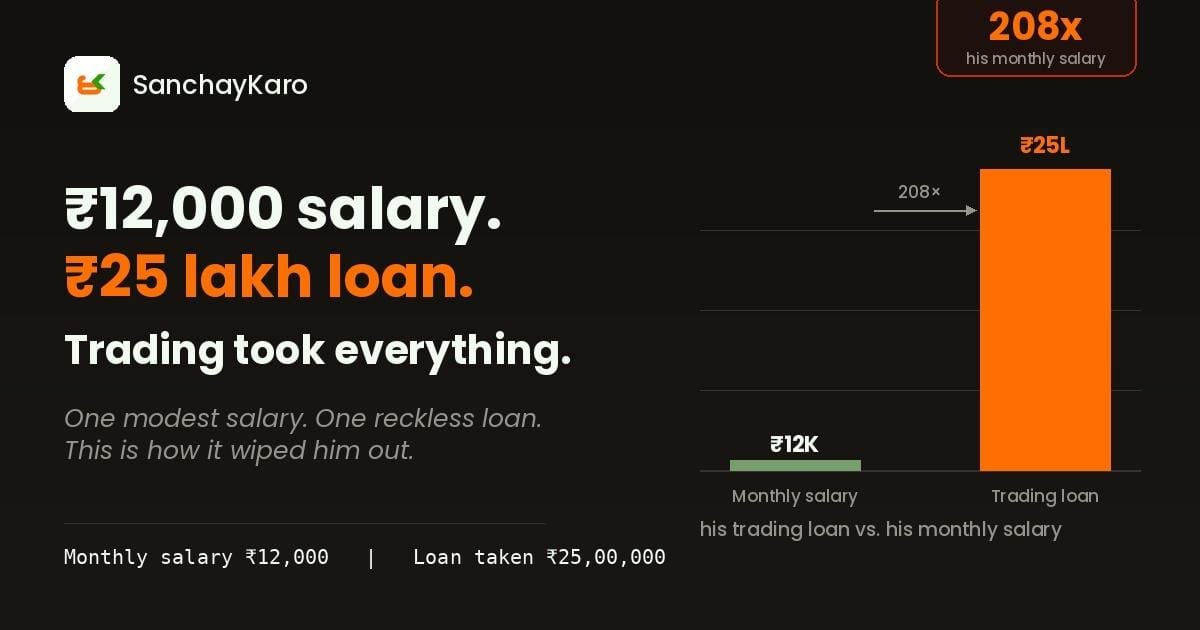
As pressure increased, Vishal began taking loans.
He says he took multiple personal loans, sometimes through several applications.
The total borrowing increased.
There was also an existing home loan.
Credit-card borrowing became part of the financial pressure.
At one point, he describes taking around ₹8–10 lakh through multiple loans.
The objective was not to build wealth anymore.
The objective had changed:
“I need to pay the people who trusted me.”
And that is a very different financial situation.
₹1.5–₹1.7 Lakh EMI Pressure
The debt became increasingly difficult to manage.
Vishal describes monthly repayments reaching approximately ₹1.5 lakh to ₹1.7 lakh.
Think about what that means.
A person who originally entered trading looking for additional income was now dealing with a monthly financial obligation that could itself become overwhelming.
Trading was no longer a way to potentially grow wealth.
It had become a desperate attempt to generate cash flow.
As the pressure continued, trading losses increased.
Vishal says his trading losses eventually went above ₹10 lakh.
The investment scheme had already created a major financial hole.
Now trading was creating another one.
Investment loss + trading loss + loans + EMIs
The combination became devastating.
And when financial pressure becomes extreme, decision-making can become even more difficult.
The Dream House Had to Be Sold
Vishal had built a home.
It represented years of work and financial stability.
But eventually, according to his story, he had to sell the house.
A house that had taken years to build was sacrificed to deal with financial obligations.
Imagine working for years to create security for your family—and then watching that security disappear because of a chain of financial decisions.
This is why trading losses should never be viewed only as numbers on a screen.
A ₹10 lakh loss isn’t necessarily just ₹10 lakh.
It can mean:
Years of savings
A family asset
Children’s security
Retirement plans
Borrowing capacity
Peace of mind
The Most Shocking Moment: Selling a Kidney
The story reaches its darkest point when Vishal says that he was so financially desperate that selling his kidney was considered as an option to raise money.
He describes having no other option in his mind.
He had people demanding their money.
He had debt.
He had already sold his house.
And he felt trapped.
This is what uncontrolled financial loss can look like.
The objective had moved from:
“I want to make money.”
to:
“I need to survive financially.”
Trading Wasn’t the Only Problem
It is important to understand the full story.
This wasn’t simply:
“He traded and lost ₹55 lakh.”
The situation involved multiple layers:
Trading losses
↓
Investment scheme
↓
Money collected from friends and relatives
↓
Funding/withdrawal problems
↓
Debt
↓
Pressure from people demanding repayment
↓
More trading to recover losses
↓
More loans
↓
More financial pressure
↓
Sale of property
↓
Extreme desperation
This is why financial risk needs to be understood beyond the individual trade.
The Biggest Lesson: Don’t Trade With Borrowed Money
One of the clearest lessons from Vishal’s story is simple:
Never take a loan simply because you believe trading profits will repay it.
Trading returns are uncertain.
Loan EMIs are not.
Your bank doesn’t say:
“Don’t worry, pay the EMI whenever your trading strategy makes a profit.”
The EMI arrives regardless of whether the market goes up or down.
If a trader uses borrowed money and experiences a large loss, the debt remains.
And interest continues.
Don’t Trade to Recover a Previous Loss
This is perhaps the most important lesson.
Suppose you lose ₹5 lakh.
Your next thought should not be:
“How can I make ₹5 lakh quickly?”
Because that mindset can encourage excessive risk.
Instead:
Stop. Review. Accept the loss. Protect whatever capital remains. Rebuild gradually.
Trying to recover yesterday’s loss tomorrow can turn a manageable financial setback into a much larger disaster.
Don’t Confuse a Few Profitable Trades With Skill
Vishal’s early experience is a powerful example.
He made money from relatively small capital.
That made trading appear easy.
But the market doesn’t owe anyone the same result tomorrow.
A few successful trades can happen because of:
Market conditions
Timing
Luck
Leverage
Volatility
Temporary strategy effectiveness
The real question is whether the process remains sustainable across different market conditions.
Why Sanchay Karo Takes a Different Approach
Stories like this explain why Sanchay Karo was launched with a fundamentally different philosophy.
The goal isn’t to encourage people to chase the next trade.
It isn’t about:
❌ Quick money ❌ Trading signals ❌ Recovering losses ❌ Excessive leverage ❌ Borrowing money to speculate ❌ Watching the market every minute
Instead, the focus is:
Sanchay. Consistency. Long-Term Investing.
The idea is simple.
Instead of constantly asking:
“How much can I make today?”
Build a habit around:
“How consistently can I invest for my future?”
SIP and Consistency Over Speculation
For investors for whom mutual funds are suitable, a Systematic Investment Plan (SIP) can help turn investing into a regular habit.
Instead of trying to predict every market movement, an investor can focus on investing regularly according to their financial plan.
Markets will rise.
Markets will fall.
There will be corrections.
There will be bull markets.
There will be periods of uncertainty.
But a long-term investor can focus on the process rather than constantly reacting to every market movement.
The objective is not to win every day.
The objective is to remain invested and disciplined over time.
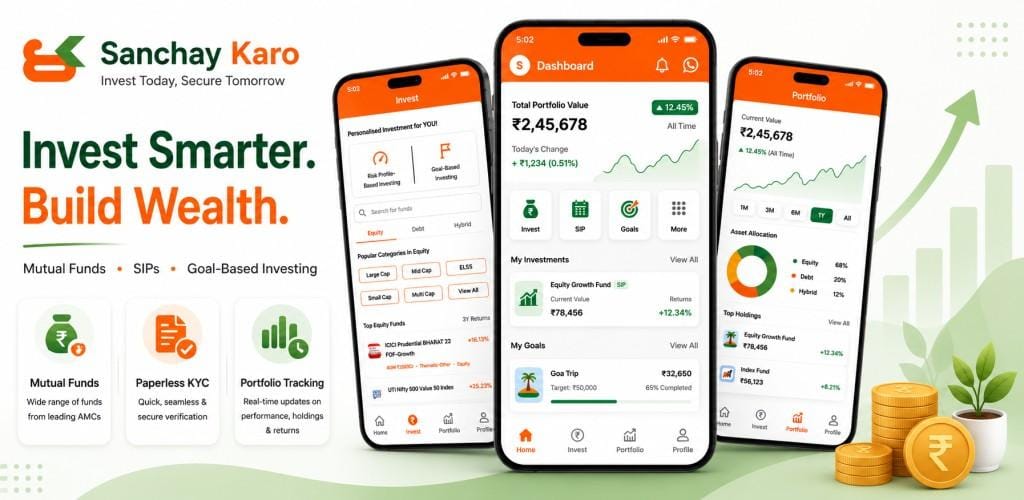
sanchay karo feature graphic
Sanchay Karo Is About Building a Habit
The philosophy behind Sanchay Karo can be summarized in four words:
Save. Invest. Stay Consistent.
Because financial wealth isn’t only about finding the highest-return opportunity.
It’s also about:
Protecting your capital
Managing risk
Avoiding unnecessary debt
Investing regularly
Staying patient
Giving compounding time to work
A boring financial habit can sometimes be more valuable than an exciting trading strategy.
Your Family’s Future Shouldn’t Depend on the Next Trade
Vishal entered the financial markets because he wanted to create a better life.
That intention is shared by millions of people.
People want:
A better home
Children’s education
Financial independence
Retirement security
More income
A better future
But those goals can be damaged when too much capital is placed into high-risk speculation.
Your investment strategy should support your life—not put your life at risk.
₹55 Lakh Is a Warning, Not a Target
The headline ₹55 lakh trading loss is shocking.
But the number itself isn’t the biggest lesson.
The lesson is what happened after the first loss.
One loss led to another attempt.
Another attempt required more money.
More money led to borrowing.
Borrowing created repayment pressure.
Repayment pressure led to more trading.
And the cycle continued.
The real danger isn’t always the first mistake.
It’s refusing to stop after the mistake.
A Better Financial Mindset
Instead of:
“I lost ₹5 lakh. I need to make ₹5 lakh tomorrow.”
Think:
“I lost ₹5 lakh. How do I make sure I don’t lose another ₹5 lakh?”
Instead of:
“How can I double my money?”
Ask:
“How can I build wealth sustainably?”
Instead of:
“Which trade can recover my losses?”
Ask:
“What financial habits can protect my future?”
These questions may sound less exciting.
But they can be far more important.
Final Lesson From Bazaar Ke Haare
Vishal’s story is a powerful reminder that financial decisions have consequences far beyond the trading screen.
The money lost in a trade can become:
A loan.
An EMI.
A family dispute.
A sold asset.
A lost opportunity.
Years of financial stress.
And, in extreme circumstances, a threat to someone’s physical and emotional wellbeing.
Trading isn’t automatically bad.
But trading without knowledge, trading with borrowed money, blindly trusting schemes or tips, and trading to recover previous losses can be extremely dangerous.
For long-term wealth creation, the better question is not:
“How quickly can I become rich?”
It is:
“How can I build financial security without putting my family’s future at risk?”
That is the philosophy behind Sanchay Karo.
Don’t chase every opportunity.
Build a habit.
Invest consistently.
Think long term.
And never let a financial loss become bigger simply because you are trying to recover it.
This article is an original editorial adaptation based on the interview/article provided and is intended for awareness and education. Statements regarding Vishal’s losses, debts, investment scheme, individuals, transactions, property sale and experiences are presented as described in the interview and have not been independently verified.
This is not financial advice. Mutual fund investments are subject to market risks; read all scheme-related documents carefully. Investors should independently evaluate financial products and consult a qualified financial professional where appropriate. Regulatory rules relating to trading, derivatives, crypto assets, overseas investments and other financial products can change; verify the current position with the relevant official authorities.
If you or someone you know is experiencing severe emotional distress or thoughts of self-harm, please seek immediate support from a mental-health professional, a trusted person, or an emergency/crisis service in your country. Financial loss can be devastating, but it can be addressed step by step. A person’s life is worth far more than any trading account, investment or debt.
Regulatory Disclosure: www.sanchaykaro.com is an online website Registered name: Mr. PALLAB ROUTH | AMFI Registered Mutual Fund Distributor | ARN – 301757 | EUIN : E572917 |Date of Registration: 22-07-2024 | Current validity: 15-07-27 |BSE STARMF Member ID: 63447|NSEMF Member ID: 1009479|MSME: UDYAM-WB-12-0123391| Self-help tool, not advisory. No charges, no return guarantees. Mutual Funds are subject to market risks. Read scheme documents. Past performance may not sustain. Check Exit Loads & TER before investing. We deal only in Regular Plans (we earn trailing commission – disclosed at investment). Direct Plans (lower expense ratio) are available but we do not deal in them.