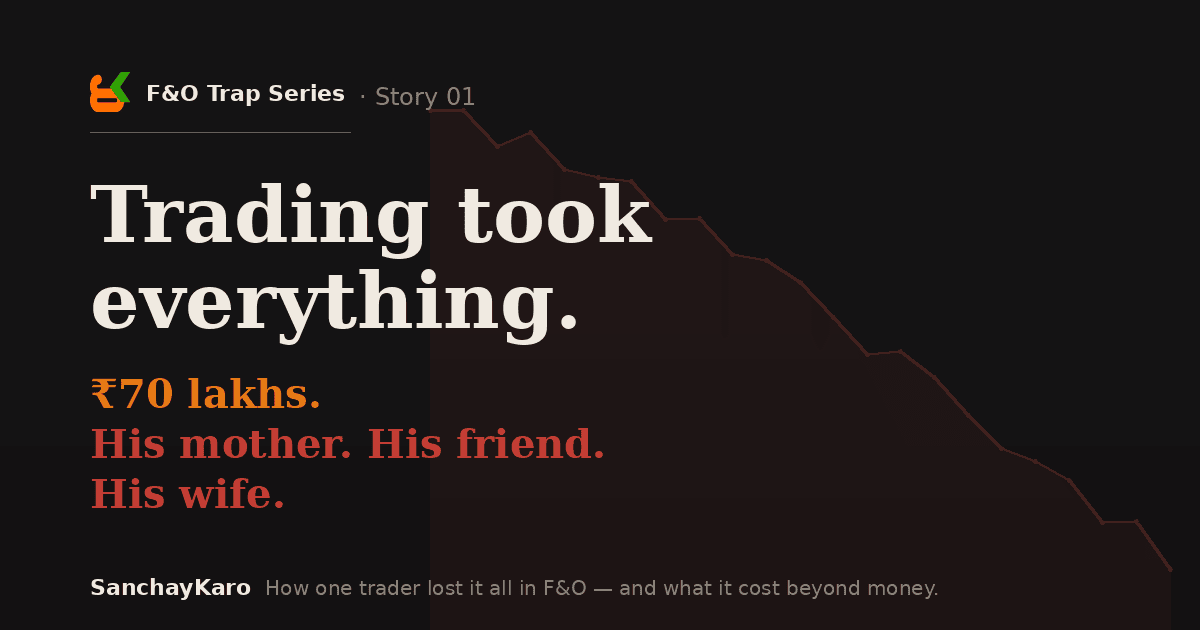
Trading Took Everything: More Than ₹70 Lakhs Lost & & His Mother,Friend & Wife
How much can a person lose while trying to make quick money from the stock market?
For Yatin from Chandigarh, the answer is more than ₹70 lakhs & & His Mother,Friend & Wife
But the biggest loss was not the money.
According to his interview, trading affected his career, marriage, relationship with his family, mental peace and friendships. He also describes experiencing severe emotional distress and suicidal thoughts during the worst period of his financial crisis.
His story is a powerful warning about what can happen when trading changes from an activity into an obsession—and when borrowed money enters the picture.
The real danger is not simply losing money. It is continuing to trade because you believe the next trade will recover everything you have already lost.
From a Stable IT Career to a ₹70 Lakh Trading Loss
Yatin was an IT engineer with a good job and salary.
His financial journey initially looked relatively normal.
In 2019, he started buying stocks with his salary. He had around ₹2 lakh invested in shares.
Then someone introduced him to options trading.
He was promised that he could make ₹10,000–₹15,000 every day.
For someone earning a monthly salary, ₹15,000 in a single day sounded extremely attractive.
His first successful trade created a dangerous impression:
“If I can make my salary in one day, why shouldn’t I do this regularly?”
That thinking became the beginning of a much bigger problem.
The First Warning: A ₹70,000–₹80,000 Loss
Yatin and a cousin started following trading calls.
Initially, the losses were manageable.
Together, they eventually lost around ₹70,000–₹80,000.
Yatin stopped trading.
For several years, he stayed away from the market.
This was actually an important decision.
The loss was painful, but it was still recoverable through normal income and disciplined financial management.
However, the story changed when he returned to trading.
The Friend Who Changed Everything
In 2023, Yatin changed companies and met a friend in Bangalore.
According to Yatin, this friend had reportedly made around ₹20 lakh profit in a year from trading.
That success influenced Yatin.
Then came the most dangerous suggestion.
The friend reportedly told him that the upcoming 2024 election result could create a major market opportunity.
The message was simple:
Borrow money. Put it into the market. The market will rise. Make a huge profit.
Yatin already had a history of trading losses.
But this time, he didn’t use only his own money.
He borrowed.
₹35 Lakh Went Into One Trade
According to the interview, Yatin took loans from multiple sources and eventually put approximately ₹35 lakh into an options position connected to the 2024 election result.
This was not ordinary investing.
It was a massive leveraged bet based on an expected market outcome.
The expectation was that the market would rise.
But the market moved sharply in the opposite direction.
And the result was devastating.
Around ₹30 lakh disappeared in a single day.
Yatin describes being unable to understand what to do.
He left on his bike.
He had no words to explain the situation to his family.
But the biggest mistake came next.
He didn’t stop.
He started thinking about recovery.
The Most Dangerous Sentence in Trading: “I Will Recover It”
After losing around ₹30–35 lakh, Yatin still had loans to repay.
There were EMIs.
There were financial obligations.
There was pressure.
And there was one thought:
“I can recover the money.”
This is where many trading losses become much larger.
A person loses ₹5 lakh.
Then tries to recover it.
The next loss becomes ₹8 lakh.
Then ₹15 lakh.
Then ₹30 lakh.
Then more borrowing begins.
Eventually, the objective is no longer wealth creation.
It becomes loss recovery.
And that is a completely different psychological game.
More Loans. More Trading. More Losses.
According to Yatin’s account, after the major loss he continued trying to generate money through trading.
He used available funds, credit cards and other borrowing.
Sometimes he made profits.
He says that after one period of trading, he could make ₹2–3 lakh.
That created another dangerous belief:
“Maybe I can really recover everything.”
But temporary profits did not solve the underlying problem.
The debt remained.
And the risk continued.
Eventually, Yatin estimates that his overall trading-related losses crossed ₹70 lakh.
The Recovery Scam Trap
After suffering major losses, Yatin says he was contacted by people who claimed they could help recover his money.
This is another dangerous stage of a trading-loss cycle.
When someone loses a large amount, they become an easy target for anyone promising:
- Guaranteed recovery
- Account handling
- Fixed returns
- Huge daily profits
- Special trading strategies
- “We know your loss”
- “Give us money and we will recover everything”
Yatin says he gave money to people who promised to help him recover losses.
He describes payments including amounts such as:
- ₹50,000
- ₹1 lakh
- ₹2 lakh
- Additional amounts afterward
At one point, someone reportedly promised him ₹5 lakh in a day after he provided more money.
The promise was unrealistic.
But when someone is already under enormous financial pressure, unrealistic promises can suddenly look like the only available solution.
Why Loss Recovery Can Become a Trap
Imagine losing ₹30 lakh.
You now have two choices.
Option 1: Accept the loss and rebuild slowly
Continue working.
Control expenses.
Negotiate debt repayment.
Stop speculative trading.
Rebuild your financial life over several years.
Option 2: Try to recover ₹30 lakh quickly
Take another loan.
Trade bigger.
Use credit cards.
Buy options.
Follow someone else’s calls.
Try another “recovery” service.
The second option can feel emotionally attractive.
But it can turn a ₹30 lakh loss into a ₹50 lakh, ₹70 lakh or even larger financial crisis.
The desire to recover quickly can become more dangerous than the original loss.
When Trading Starts Affecting Your Family
The financial damage eventually moved beyond Yatin’s trading account.
According to his account, bank representatives and recovery agents contacted him and sometimes came to his home.
He describes his family facing pressure and abusive interactions.
He eventually left home and stayed away from his family for several months.
This is where we need to understand the true cost of excessive financial risk.
A trading loss isn’t always just:
₹10 lakh loss on a screen.
It can become:
Debt → EMI pressure → family conflict → stress → isolation → health problems → relationship breakdown.
Yatin Lost More Than Money
According to the interview, Yatin’s mother died in November 2024.
He believes the financial pressure may have contributed to the distress she experienced, although that connection is his personal belief and cannot be independently established from the interview.
He also describes losing a close friend who had been involved in trading and who later died by suicide.
These are deeply serious claims, and they should not be treated as proof that trading alone caused either death.
But they demonstrate something important:
Severe financial distress can affect entire families and communities—not just the person whose trading account shows the loss.
His Marriage Also Broke Under Financial Pressure
Yatin married in 2021.
According to his account, his wife eventually left after learning about the scale of his debt and the pressure surrounding the family.
He describes feeling completely alone.
His words reveal the emotional cost of financial decisions made under pressure.
The money was gone.
The debt remained.
The relationships were damaged.
And the feeling of regret became difficult to escape.
“I Lost My Family Along With My Money”
Perhaps the most painful lesson from Yatin’s story is that money can sometimes be recovered.
But time cannot.
A financial loss can potentially be rebuilt over five, ten or fifteen years.
But lost relationships, lost trust and lost peace of mind may not return so easily.
This is why financial decisions should never be judged only by their potential return.
We should also ask:
What happens if this decision goes completely wrong?
The Psychology Behind the ₹70 Lakh Loss
Yatin’s story highlights several common psychological traps.
1. The Shortcut Mentality
The first attraction is simple:
“Why work for years when I can make money today?”
Trading appears to offer speed.
But speed works both ways.
Money can disappear faster than it can be earned.
2. Borrowing to Trade
This is one of the biggest warnings from the story.
Yatin says he borrowed approximately ₹35 lakh for the major election trade and later used other forms of borrowing.
When you invest your own savings and lose money, the loss is painful.
When you borrow money and lose it, you still have to repay the original debt plus the cost of borrowing.
That creates a completely different level of pressure.
3. Trading Based on Someone Else’s Confidence
The friend reportedly had a successful year.
That success created confidence.
But one person’s previous trading profit does not guarantee another person’s future profit.
The question should always be:
Can I afford the loss if this trade goes completely wrong?
If the answer is no, the trade may already be too risky.
4. The Recovery Trap
This was arguably the biggest problem.
Instead of accepting the loss, Yatin kept trying to recover it.
The market became a tool for repairing the damage caused by the market.
That creates a dangerous cycle:
Loss → Recovery attempt → Bigger risk → Bigger loss → More borrowing → More recovery attempts.
5. Unrealistic Return Expectations
Someone promising ₹5 lakh from ₹50,000 should immediately raise questions.
Extraordinary returns require extraordinary risk.
And even when a very large return is technically possible in a particular trade, that doesn’t mean it is consistently achievable.
Possible is not the same as probable.
Why Sanchay Karo Takes a Different Approach
This is exactly where Sanchay Karo follows a different philosophy.
The purpose is not to encourage people to chase the next big trade.
It is not built around:
- Daily trading
- F&O speculation
- Borrowed money
- Market tips
- Recovery trading
- Overnight wealth
- Unrealistic returns
Instead, the focus is much simpler:
Save. Invest. Stay Consistent. Grow.
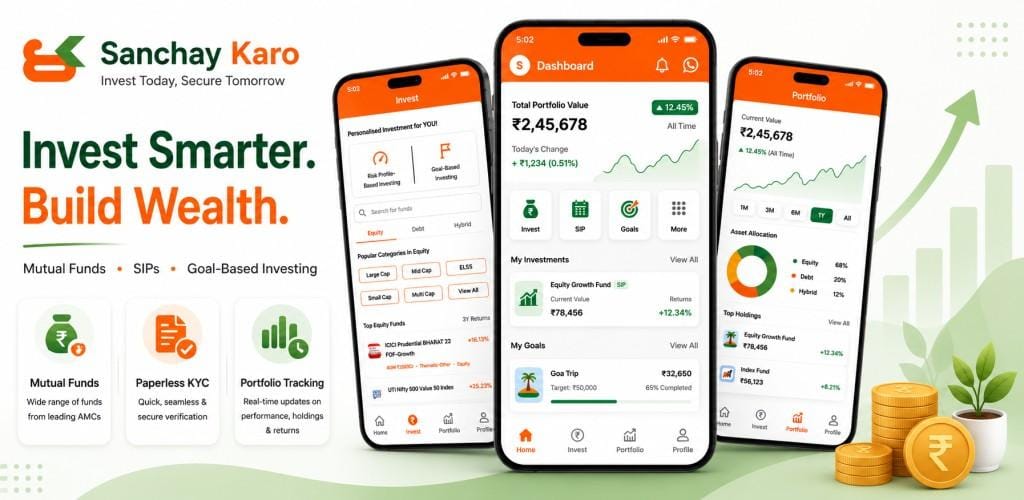
Sanchay Karo focuses on mutual fund investment as a disciplined, long-term approach to wealth creation.
The philosophy is based on an important idea:
You don’t need to become rich tomorrow. You need to build financial discipline today.
Mutual Funds and SIP: A Different Mindset
A systematic investment approach can change the way people think about money.
Instead of asking:
“How much can I make today?”
You start asking:
“How much can I invest consistently for the next 10 years?”
That is a completely different mindset.
A SIP can help investors create a regular investment habit by contributing a fixed amount periodically.
For example, instead of taking ₹5 lakh and making a high-risk market bet, someone might choose to invest an affordable amount regularly into suitable mutual fund schemes based on their financial goals and risk profile.
The objective isn’t to predict tomorrow’s market.
The objective is to stay invested for the long term.
Sanchay Karo: Consistency Over Excitement
Trading often creates excitement.
A green screen creates excitement.
A quick profit creates confidence.
A large loss creates fear.
Then the investor wants another trade.
This emotional cycle can become exhausting.
Long-term investing is different.
There may be nothing exciting about investing every month.
And that’s exactly the point.
Wealth creation doesn’t always need excitement. It needs consistency.
Sanchay Karo’s philosophy is therefore centered on mutual fund investing and disciplined accumulation, rather than encouraging people to chase fast profits through speculative trading.
What Yatin’s Story Teaches Us
There are several lessons every investor can take from this story.
Never trade with borrowed money.
If a trade goes wrong, the market doesn’t care about your EMI.
Don’t put your financial future on one market prediction.
Election results, news events and market expectations can produce unexpected moves.
Don’t blindly follow friends.
A friend’s success is not a guarantee of your success.
Don’t chase losses.
A loss does not have to be recovered through another trade.
Be extremely careful with “recovery” promises.
Someone promising to recover your trading loss quickly may create another loss.
Don’t make trading your only source of income.
Your salary, business or profession should not be sacrificed to support speculative trading.
Build wealth patiently.
For many long-term investors, mutual funds and SIPs can be part of a disciplined investment strategy when selected according to goals, time horizon and risk tolerance.
The Biggest Lesson: Protect Your Life Before Your Money
Yatin’s story is not really about ₹70 lakh.
It is about what can happen when financial losses become more important than everything else.
A person may lose money.
But money can potentially be earned again.
Your health matters.
Your family matters.
Your relationships matter.
Your peace of mind matters.
No trading profit is worth risking your entire life.
Watch the Full Story
If you want to understand Yatin’s journey directly from his interview, watch the full episode of Bazaar Ke Haare:
Watch the full Bazaar Ke Haare episode on YouTube
Final Thought
The stock market can be a powerful tool for wealth creation.
But there is a huge difference between investing for the future and gambling for a quick recovery.
Yatin’s story shows what can happen when trading becomes driven by greed, borrowed money, emotional decisions and the desperate desire to recover losses.
There is another path.
Save regularly. Invest responsibly. Stay consistent. Give your money time to grow.
That is the philosophy behind Sanchay Karo.
Because the goal should never be to make money at any cost.
The goal should be to build wealth without losing the life you are trying to improve.
Disclaimer
This article is an original editorial adaptation based on the interview/article provided and is intended for awareness and education. Statements regarding Yatin’s losses, debts, trading activities, individuals, transactions, family circumstances and experiences are presented as described in the interview and have not been independently verified.
This is not financial advice. Mutual fund investments are subject to market risks; read all scheme-related documents carefully. Investors should independently evaluate financial products and consult a qualified financial professional where appropriate. Regulatory rules relating to trading, derivatives, crypto assets, overseas investments and other financial products can change; verify the current position with the relevant official authorities.
If you or someone you know is experiencing severe emotional distress or thoughts of self-harm, please seek immediate support from a mental-health professional, a trusted person, or an emergency/crisis service in your country. Financial loss can be devastating, but it can be addressed step by step. A person’s life is worth far more than any trading account, investment or debt.