If you have started exploring mutual fund investment, you may have heard the term mid cap fund. But what does it mean? Is it safe? Should you invest? This blog will explain what is a mid cap fund in very simple language. You will also learn how to invest easily using the Sanchaay Karo app.
What is a Mid Cap Fund? (Very Simple Definition)
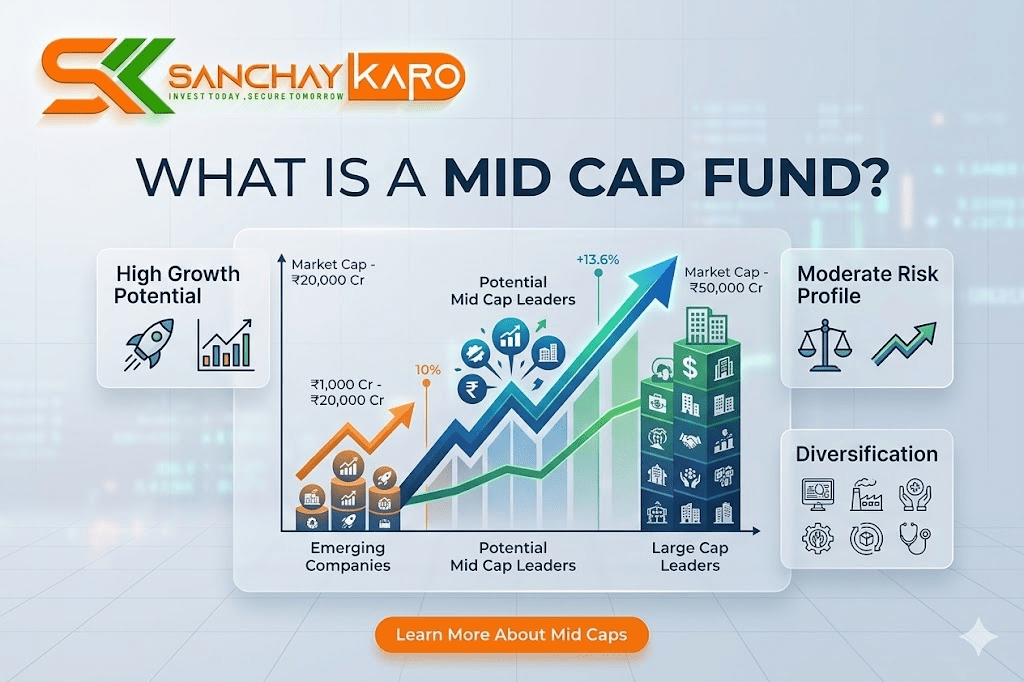
A mid cap fund is a type of equity mutual fund that invests most of its money in mid cap stocks. According to SEBI rules, a mid cap fund must invest at least 65% of its total assets in equity of mid cap companies – meaning companies ranked 101 to 250 by market capitalisation in India.
Think of it like this: If large cap companies are the giant banyan trees, mid cap companies are the fast-growing mango trees. They are not yet the biggest, but they have lots of room to grow. Mid cap stocks are often called the “rising stars” of the stock market. They are established businesses that are expanding rapidly.
When you invest in a mid cap mutual fund, you are putting your money into companies that have already proven themselves but are still in a high growth phase. These companies typically have a market cap between ₹5,000 crore and ₹20,000 crore (though this range changes with market conditions).
How Does a Mid Cap Fund Work?
Mid cap funds pool money from many investors. A professional fund manager then invests that money across a basket of mid cap stocks from different sectors like banking, IT, pharma, auto, or manufacturing.
The fund manager studies company financial reports, tracks earnings growth, monitors industry trends, and decides which mid cap stocks to buy or sell. The net asset value (NAV) of the fund changes daily based on how these mid cap companies perform in the stock market.
Here is a simple example: Suppose you invest ₹10,000 in a mid cap fund. The fund manager will allocate at least ₹6,500 (65%) to mid cap stocks. The remaining 35% can be in large caps, small caps, debt, or cash. Your money is now spread across many growing businesses, which gives you diversification and the chance to earn higher returns than large cap funds.
Key Features of Mid Cap Funds
| Feature | What It Means |
|---|---|
| SEBI Mandate of 65% | At least 65% of assets must be in companies ranked 101-250 by market cap |
| Higher Growth Potential | Mid caps can grow faster than large caps because they are in an expansion phase |
| Moderate to High Volatility | Prices can go up and down more than large caps, but less than small caps |
| Good Liquidity | Most mid cap stocks are actively traded, though not as much as large caps |
| Active Management | Fund managers actively pick stocks to maximise returns |
| Long Term Wealth Creation | Historically, mid caps have delivered excellent returns over 7-10 years |
Benefits of Investing in Mid Cap Funds
Here are the top benefits of adding a mid cap fund to your mutual fund portfolio:
| Benefit | Why It Matters |
|---|---|
| Higher Return Potential | Mid cap companies can grow 2-3 times faster than large caps during economic booms |
| Opportunity to Spot Future Leaders | Many of today’s large caps were mid caps 10-15 years ago. You get in early |
| Diversification | Your money is spread across many fast-growing businesses |
| Less Crowded than Large Caps | Mid cap stocks are not as heavily tracked, so skilled fund managers can find hidden gems |
| Ideal for Long Term Goals | Perfect for goals like retirement, children’s education, or buying a house (7+ years) |
| Power of Compounding | When a mid cap grows, the compounding effect can significantly boost your wealth |
Mid cap funds have historically delivered better returns than large cap funds over long periods. According to studies, the Nifty Midcap 100 index has outperformed the Nifty 50 in 7 out of the last 10 years.
Who Should Invest in Mid Cap Funds? (Ideal Investor Profile)
Mid cap funds are perfect for:
- Investors with a high risk appetite who can handle market ups and downs
- Long term investors with an investment horizon of 7 to 10 years or more
- Young professionals who want to build wealth creation for the future
- Salaried individuals who can start a Systematic Investment Plan (SIP) with a small amount
- Experienced investors who already have large cap funds in their core portfolio and want to add growth
- People saving for long term goals who are not afraid of market volatility
Who should avoid Mid Cap Funds?
- Beginners who are new to equity mutual fund investment (start with large cap funds first)
- Conservative investors who cannot tolerate moderate to high volatility
- People who need their money back within 5 years
- Retirees who depend on stable regular income
As one expert says: “Mid cap funds are not for the faint-hearted. They can give you sleepless nights during market corrections, but if you stay invested, the rewards can be life-changing.”
Mid Cap Fund vs Large Cap Fund vs Small Cap Fund (Simple Comparison)
Many beginners get confused between different types of equity mutual funds. Here is a simple comparison based on SEBI rules:
| Fund Type | SEBI Rule | Risk Level | Return Potential | Best For |
|---|---|---|---|---|
| Large Cap Fund | Min 80% in top 100 companies | Low to Moderate | Moderate (10-12%) | Conservative investors, beginners |
| Large & Mid Cap Fund | Min 35% each in large and mid caps | Moderate | Moderate to High | Balanced investors |
| Mid Cap Fund | Min 65% in companies 101-250 | Moderate to High | High (12-15%) | Growth-focused investors |
| Small Cap Fund | Min 65% in 251st company onwards | Very High | Very High (15-20%) | Aggressive investors |
| Flexi Cap Fund | Min 65% equity, no cap restrictions | Moderate to High | Varies | Investors wanting flexibility |
| Multi Cap Fund | Min 25% each in large, mid, small | High | High | Those wanting full market exposure |
| Focused Fund | Max 30 stocks, min 80% equity | High | High | Experienced investors |
Mid cap funds sit in the middle of the risk-return spectrum. They offer higher returns than large cap funds but with higher volatility. They are less risky than small cap funds but also offer lower potential returns.
Top Mid Cap Funds in India (2026)
Here are some of the best mid cap funds in India based on assets under management (AUM) and 3-year returns:
| Fund Name | AUM (₹ Crore) | 3-Year Return (%) | Expense Ratio (Direct) |
|---|---|---|---|
| HDFC Mid-Cap Opportunities Fund | 81,000 | 32.05% | 0.80% |
| Kotak Emerging Equity Fund | 52,000 | 29.80% | 0.75% |
| Axis Midcap Fund | 31,000 | 26.50% | 0.85% |
| Nippon India Growth Fund | 29,000 | 31.20% | 0.70% |
| SBI Magnum Midcap Fund | 23,000 | 28.40% | 0.82% |
| PGIM India Midcap Opportunities Fund | 11,000 | 30.10% | 0.68% |
| Edelweiss Mid Cap Fund | 7,500 | 27.90% | 0.65% |
| Quant Mid Cap Fund | 6,800 | 34.50% | 0.90% |
| Invesco India Mid Cap Fund | 5,900 | 26.80% | 0.72% |
| Franklin India Prima Fund | 4,500 | 25.60% | 0.88% |
Data sources: Value Research, Morningstar India, Moneycontrol (approx figures for illustration)
HDFC Mid-Cap Opportunities Fund is the largest mid cap fund in India with an AUM of over ₹81,000 crore. It has delivered 32% returns in the last 3 years. Quant Mid Cap Fund has given even higher returns at 34.5%, but with higher volatility.
Disclaimer: Past performance does not guarantee future returns. Please consult your financial advisor before investing.
Historical Returns of Mid Cap Funds
Mid cap funds have delivered impressive returns over the long term. According to historical data:
- 3-year returns: Between 25% and 35% annualised (as of 2026)
- 5-year returns: Between 15% and 20% annualised
- 10-year returns: Between 16% and 18% annualised
- 15-year returns: Over 18% annualised
A lump sum of ₹1 lakh invested in a top mid cap fund 10 years ago would have grown to approximately ₹5-6 lakh today. A monthly SIP of ₹5,000 in a mid cap fund over 10 years could build a corpus of over ₹12-15 lakh, depending on returns.
However, mid cap funds can also fall sharply during market corrections. In 2020 (COVID crash), many mid cap funds fell by 30-40%. But they recovered strongly in the following years. This is why a long term horizon is crucial.
Risks of Mid Cap Funds (Must Read)
No mutual fund investment is without risk. Here are the risks of mid cap funds:
| Risk | Explanation |
|---|---|
| Higher Volatility | Mid cap stocks can fall 20-30% in a market crash, much more than large caps |
| Business Risk | Mid cap companies are less established than large caps. A bad quarter can hit their stock price hard |
| Liquidity Risk | Some mid cap stocks may be harder to sell quickly during a panic |
| Fund Manager Risk | Your returns depend heavily on the fund manager’s skill in picking the right mid caps |
| No Guaranteed Returns | These are not like fixed deposits. Returns depend on market conditions and company performance |
| Underperformance Risk | Sometimes, large caps or small caps may outperform mid caps for years |
However, over a long period (7-10 years) , mid cap funds have historically delivered excellent returns that beat inflation and large cap funds. The key is to stay invested through ups and downs.
Taxation on Mid Cap Funds (Simple Rules)
Since mid cap funds invest more than 65% in equity, they are treated as equity-oriented funds for taxation purposes. This is the same as large cap funds.
| Type | Holding Period | Tax Rate |
|---|---|---|
| Short Term Capital Gains (STCG) | Less than 12 months | 20% (flat) |
| Long Term Capital Gains (LTCG) | 12 months or more | 12.5% on gains above ₹1.25 lakh per year |
Key tax rules:
- Gains up to ₹1.25 lakh in a financial year are tax-free
- Any LTCG above ₹1.25 lakh is taxed at 12.5% (without indexation benefit)
- STCG is taxed at a flat 20% regardless of your income tax slab
- If the fund gives you a dividend (IDCW option), it is added to your income and taxed as per your income tax slab
- The fund deducts 10% TDS under Section 194K if your dividend from a fund house exceeds ₹5,000 in a financial year
Important: Because mid cap funds can be volatile, it is often wise to hold them for more than 12 months to benefit from the lower LTCG tax rate of 12.5% instead of the flat 20% STCG rate.
How to Start a Mid Cap Fund SIP? (Using Sanchaay Karo App)
Now that you understand what a mid cap fund is and why it is great for wealth creation, the next step is investing. The easiest way is through the Sanchaay Karo app.
Sanchaay Karo is a simple, trusted, and SEBI-registered mutual fund investment platform. It helps you invest in top mid cap funds and hundreds of other funds with just a few taps.
Why Choose Sanchaay Karo App for Mid Cap Fund Investment?
- Smart Goal-Based Investing: Tell the app your goal (retirement, child’s education, buying a house). It suggests the right mid cap fund based on your risk appetite and investment horizon
- Simple Dashboard: See all your investments in one place – no confusion or clutter. Track NAV, returns, and portfolio in real time
- Quick KYC: Complete your KYC online using Aadhaar and PAN in just 5 minutes. Paperless KYC is fully supported
- Start SIP from ₹500: You don’t need a lot of money. Start small with a Systematic Investment Plan (SIP) . You can do monthly SIP, weekly SIP, or even daily SIP
- Track Performance: Get regular updates on how your mid cap mutual fund is performing against its benchmark (like Nifty Midcap 100)
- No Hidden Charges: Transparent and low-cost. You can choose between regular plan and direct plan options. Direct plans have lower expense ratios
- Stay On Track: Get timely reminders so your SIPs never stop
- Access to All AMCs: Invest in HDFC Mid Cap Fund, Kotak Emerging Equity Fund, Nippon India Growth Fund, and many more
Steps to Invest in Mid Cap Funds (Very Easy)
- Download the Sanchaay Karo app from Google Play Store or Apple App Store
- Sign up using your mobile number and email
- Complete KYC – upload PAN card and Aadhaar (fully paperless). You can also do video KYC if needed
- Search for “Mid Cap Fund” or let the app recommend one based on your financial goals
- Compare different mid cap funds based on returns, expense ratio, exit load, and fund manager track record
- Choose between lumpsum (one-time) or monthly SIP investment. For beginners, SIP is recommended
- Pay using UPI, net banking, or debit card
- Done! Your investment starts growing. You will receive regular statements
👉 [Click Here to Download Sanchaay Karo App Now] (https://apirrabbit.com/api/v1/master/LandingPage?arn=ARN-301757)
Important Tips Before Investing in Mid Cap Funds
Before you invest in a mid cap mutual fund, keep these points in mind:
- Check the Fund Manager’s Track Record: Look for consistent performance across different market cycles. A good fund manager with experience in mid cap investing is crucial
- Understand the Portfolio: Look at the top holdings and sector allocation. Are these companies you believe in? Check for portfolio overlap with funds you already own
- Compare Expense Ratios: Expense ratio can impact your long-term returns. Direct plans have lower expense ratios (typically 0.5-1.0%) than regular plans (1.0-2.0%). Over 10 years, this difference can be significant
- Check Exit Load: Most mid cap funds have an exit load of 1% if you redeem within 1 year. Some funds may have 0.5% exit load after 1 year. Make sure you understand this before investing
- Have a Long Time Horizon: Mid cap funds work best when you stay invested for 7 to 10 years or more. Equities can be volatile in the short term, but mid caps need time to realise their growth potential
- Start with a Small Allocation: If you are new to mid cap funds, start with a small portion of your portfolio – maybe 10-20%. Add more as you become comfortable with volatility
- Don’t Panic During Falls: Mid cap funds can fall 20-30% in a market correction. This is normal. Do not sell in panic. Instead, continue your SIP or even increase it to buy more units at lower prices
- Review Annually: Review your mutual fund portfolio at least once a year. Rebalance if needed based on your financial goals and risk profile
- Avoid Chasing Past Returns: A fund that gave 35% returns last year may not repeat it. Look for consistency over 5-10 years, not just 1 year
- Consider Your Overall Asset Allocation: Do not put all your money in mid cap funds. Combine them with large cap funds, debt funds, and gold for a balanced portfolio
Mid Cap Funds vs Mid Cap Stocks (Direct Investing)
Some investors ask: Should I buy mid cap stocks directly or invest in a mid cap fund?
| Aspect | Mid Cap Fund | Direct Mid Cap Stocks |
|---|---|---|
| Diversification | Instant diversification across 30-50 stocks | You need to buy many stocks yourself |
| Research Required | Fund manager does all research | You must study each company |
| Risk | Spread out, lower single-stock risk | Higher risk if one stock fails |
| Time Required | Almost none after investment | Significant time for tracking |
| Cost | Expense ratio (0.5-1.5%) | Brokerage, transaction costs |
| Expertise Needed | None | High |
For most beginners and even experienced investors, mid cap funds are a better choice than buying individual mid cap stocks. You get professional management, diversification, and peace of mind.
Frequently Asked Questions (FAQs) About Mid Cap Funds
Q1: Are mid cap funds safe?
A: No equity mutual fund is 100% safe. Mid cap funds have moderate to high risk. But if you invest for 7-10 years, the risk reduces significantly.
Q2: Can I lose money in mid cap funds?
A: Yes, in the short term, you can lose money. If you invest at a market peak and sell during a crash, you may get back less than you invested. That is why a long term horizon is important.
Q3: What is the minimum SIP amount for mid cap funds?
A: Most mid cap funds allow SIP starting from ₹500 per month. Through the Sanchaay Karo app, you can start with as little as ₹500.
Q4: How much returns can I expect from mid cap funds?
A: Historically, mid cap funds have delivered 12-15% annual returns over 10-year periods. In some years, they give 30%+, in others they may give negative returns. But over the long term, they beat large cap funds.
Q5: Should I invest in mid cap funds now (2026)?
A: Market timing is difficult. The best approach is to start a SIP and stay invested for the long term. Do not try to predict the market.
Q6: Are mid cap funds good for retirement?
A: Yes, if you are young (20s or 30s) and have 20-30 years for retirement. Mid cap funds can be part of your retirement planning portfolio. As you near retirement, shift to large cap funds or debt funds.
Q7: What is the difference between mid cap and small cap funds?
A: Mid cap funds invest in companies ranked 101-250. Small cap funds invest in companies ranked 251 and below. Small caps are riskier and more volatile.
Q8: Can NRIs invest in mid cap funds?
A: Yes, NRIs can invest in mid cap funds through Sanchaay Karo app using their NRE/NRO account.
Final Words – Should You Invest in a Mid Cap Fund?
Yes, if you:
- Have a high risk appetite or at least moderate to high risk tolerance
- Have a long term horizon of 7 to 10 years or more
- Are a young professional or someone in your 20s/30s
- Already have large cap funds as a core portfolio and want to add growth
- Want to build wealth creation for goals like retirement or children’s education
- Can handle market volatility without panicking
No, if you:
- Are a beginner with no experience in equity mutual funds (start with large cap funds first)
- Have a low risk tolerance and cannot sleep when markets fall
- Are a conservative investor or a retiree needing stable regular income
- Need your money back within 5 years
Mid cap funds are among the most powerful tools for wealth creation in India. They have consistently outperformed large cap funds over long periods. However, they come with higher volatility. The key is to start early, invest through SIP, and stay invested for at least 7-10 years.
As the famous saying goes: “Time in the market is more important than timing the market.” This is especially true for mid cap funds.
So stop waiting. Start your investment journey today with the Sanchaay Karo app. Your future self will thank you for making this smart choice.
👉 [Click Here to Download Sanchaay Karo App Now] (https://apirrabbit.com/api/v1/master/LandingPage?arn=ARN-301757)
Disclaimer: This blog is for educational purposes only. Mutual fund investments are subject to market risks. Please read all scheme related documents carefully, including the Scheme Information Document (SID) and Statement of Additional Information (SAI), and consult your financial advisor before investing. Past performance does not guarantee future returns. The Sanchaay Karo app is a platform for mutual fund investments; all investments are subject to market risk.
RELATED POSTS
View all

₹2000 Monthly SIP – Can You Reach ₹10 Lakhs?
April 5, 2026 | by sanchaykaro@gmail.com
Understanding Mutual Funds: A Simple Guide for Indian Investors
December 16, 2025 | by sanchaykaro@gmail.com